
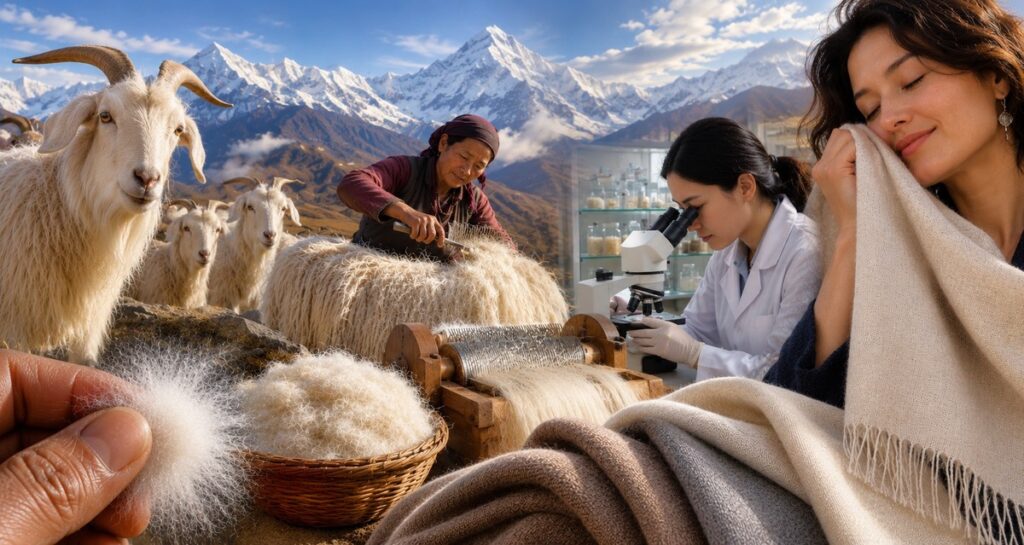
The word “pashmina” as used in contemporary English has four common meanings:
Current usage of the term “pashmina”
1) A pashmina goat is a cashmere goat.
The scientific name for all domestic goats is Capra hircus (“laniger” has no standing as a scientific name with regards to goats.)
There are about three hundred breeds of domesticated goats worldwide, of which about a dozen are characterized as cashmere goats, meaning that they may be used to produced cashmere. In the context of Central Asia, or in the parlance of people with an Asian perspective, these animals may be called pashmina goats.

2) Pashmina fiber or yarn is precisely the same as cashmere: wool fiber from the downy undercoat produced by domesticated goats. Most domestic goat breeds do not produce enough down, or down of high enough quality, to be useful on a commercial basis.
To complicate matters, the guard hair of pashmina (cashmere) goats can also be used for textiles, but that fabric should not properly be termed cashmere or pashmina.
To complicate even further, a certain percentage of non-down fiber (for example cashmere goat guard hairs) can be tolerated in pashmina/cashmere fabric; that percentage was 3% at one time, and is now apparently 5%. This is partly because it is hard to completely dehair the wool (i.e., remove the guard hairs), but also because (legal) adulteration enhances the producer’s profit margin.
So… pashmina yarn may contain non-pashmina fiber and that fiber may actually be derived from the pashmina/cashmere goat.

3) By extension, pashmina fabric is fabric woven from cashmere. By even greater extension, it refers to fabric woven from a mix of cashmere and some other fiber. A common composite is 70% cashmere and 30% silk, but other proportions (especially 80/20) are not uncommon. (In the past, the difference has depended on what gauge silk was used for the warp. Note that heavier silk is neither better nor worse than lighter.) In addition, cashmere may be mixed with sheep’s wool (often merino) or cotton, and likely with quite a few other fibers. These non-cashmere components make the cloth heavier, stronger, and more tolerant of embroidery.

4) Again, by extension, a pashmina (i.e., pashmina shawl) is a wrap woven of cashmere or a cashmere blend. More loosely, the term can refer to any textile configured to resemble such a wrap: generally, a large fringed shawl. Such a “pashmina” may have no cashmere or even wool content at all: in fact, “faux pashmina” (or fake pashmina) synthetics such as polyester, rayon, acrylic, and viscose are quite common.

Multiple meanings: not a problem
There is nothing especially unusual, much less deceptive, in the lexical flexibility of the word “pashmina.” Parallels are quite common in the agricultural and horticultural sectors. For example, “milk”: we can speak of “milk cows,” as well as the product milk; milk can be an ingredient, or (whether homogenized, pasteurized, skimmed, or whole), a beverage; in addition, there are numerous sorts of milk or milk replacements derived from an array of animals and plants. All can legitimately be referred to as “milk.” A similar situation applies for the words tomato, banana, lavender, and coffee, which can refer to a plant, a fruit or flower, an ingredient, a taste, a color, and a product (or simulacrum).
Synonyms: not a problem
Nor is it particularly odd to have multiple words with essentially the same meaning, especially when one is technical and the other more colloquial, or one is indigenous and the other applied by colonial or exogenous “discoverers”: think of India rubber, rubber, latex, caucho, or caoutchouc. Or gum and chicle. Or frankfurter and hotdog.
Pashmina is simply an autochthonous word, deriving from the Persian pashm (wool, or woven fabric, of whatever provenance), while cashmere is an older spelling of Kashmir, which is where Europeans first encountered the fabric. It’s kind of like calling denim “America” or “American” … or calling ground beef “Hamburg” or “Hamburger.”
Contradictions: a problem
The more problematic confusion, in the case of pashmina and cashmere, stems from attempts to distinguish between them, and particularly to claim special standing for pashmina. Most of these claims come directly or indirectly from purveyors trying to bolster the competitive positioning of their own product.
Such claims generally focus on the source of the fiber, and we will get into the technical details in a later post. For now, we can settle the issue by referring to the United States Federal Trade Commission (FTC), which regulates commercial labeling and protects consumers from deceptive practices.
What the FTC says
The American Federal Trade Commission (FTC) is the agency that regulates commercial labeling in the United States and protects consumers from deceptive practices. According to the FTC, pashmina is not a valid term in labeling, because it does not have a single, unambiguous meaning.
In an on online article entitled Cachet of Cashmere: Complying with the Wool Products Labeling Act, we find the following passage:
The popularity of products marketed as pashmina — an Indian word for cashmere — has soared in recent years, yet most consumers aren’t sure what pashmina is. That’s not surprising, as pashmina is not a labeling term recognized by the Wool Act and Rules. Experts tell the FTC there is no pashmina fiber that is separate and distinct from the cashmere fiber.

Some manufacturers use the term pashmina to describe an ultra fine cashmere fiber; others use it to describe a blend of cashmere and silk. The FTC encourages manufacturers and sellers of products described as pashmina to use a hang-tag or other mechanism to explain to consumers what they mean by the term. The fiber content of a shawl, scarf or other item marketed as pashmina must be accurately disclosed. For example, a blend of cashmere and silk might be labeled 50% Cashmere, 50% Silk, or 70% Cashmere, 30% Silk, depending upon the actual cashmere and silk content. If the item contains only cashmere, it should be labeled 100% Cashmere or All Cashmere. The label cannot say 100% Pashmina, because pashmina is not a fiber recognized by the Wool Act or regulations. [emphasis added]
In short, pashmina is cashmere.
Leave a Reply