
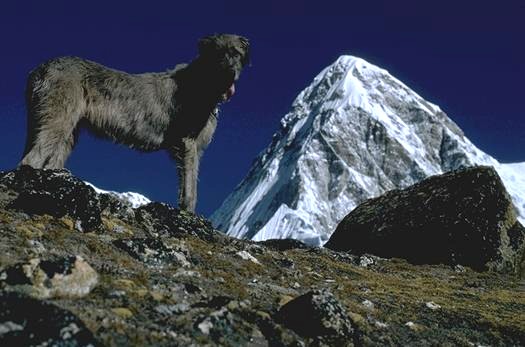
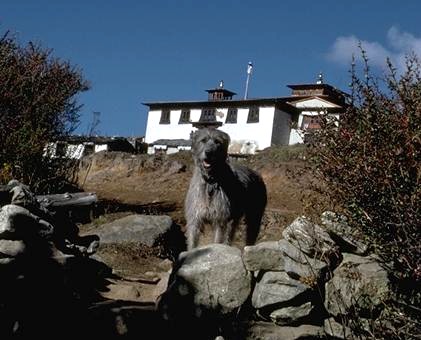
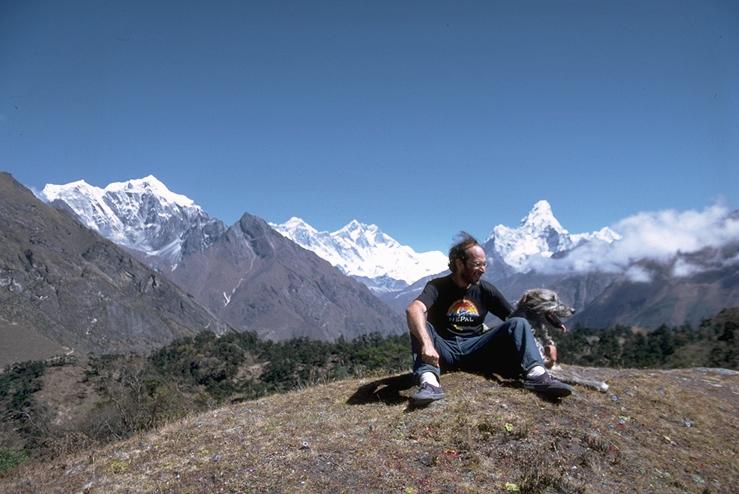
In 1988 I spent seven months in Nepal with Namche, my Irish Wolfhound. She was named after Namche Bazar, the Sherpa town I first visited in 1975, and which became my home base during fieldwork in nearby Khumjung in the winter of 1982–83.
Nobody in Nepal had ever seen a dog like her.
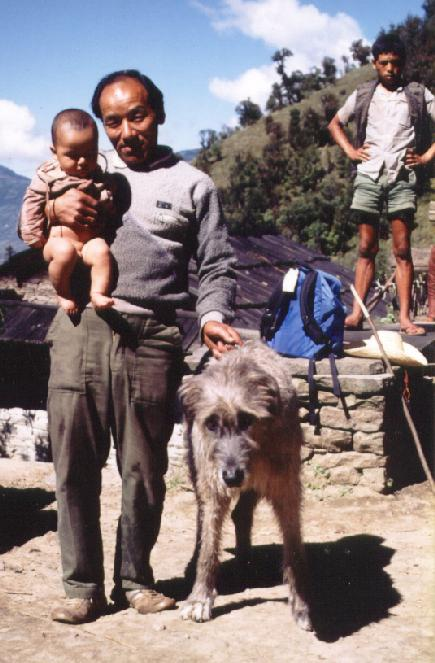
Namche was not particularly large for an Irish Wolfhound—about 31 inches at the shoulder and perhaps 125 pounds—but in Nepal she caused a sensation. Walking anywhere took time. People would stop us and ask the same questions.
Is it a dog?
Does it bite?
What is its name?
How much does it eat?
When I decided to take Namche trekking from Jiri toward Everest, I thought I had found a solution. I had a T-shirt embroidered with the answers in Nepali:
Kukur ho. It’s a dog.
Tokdaina. She doesn’t bite.
Naam Namche ho. Her name is Namche.
Dindinai dedh kilo maasu. A kilo and a half of meat every day.
It was not a success.
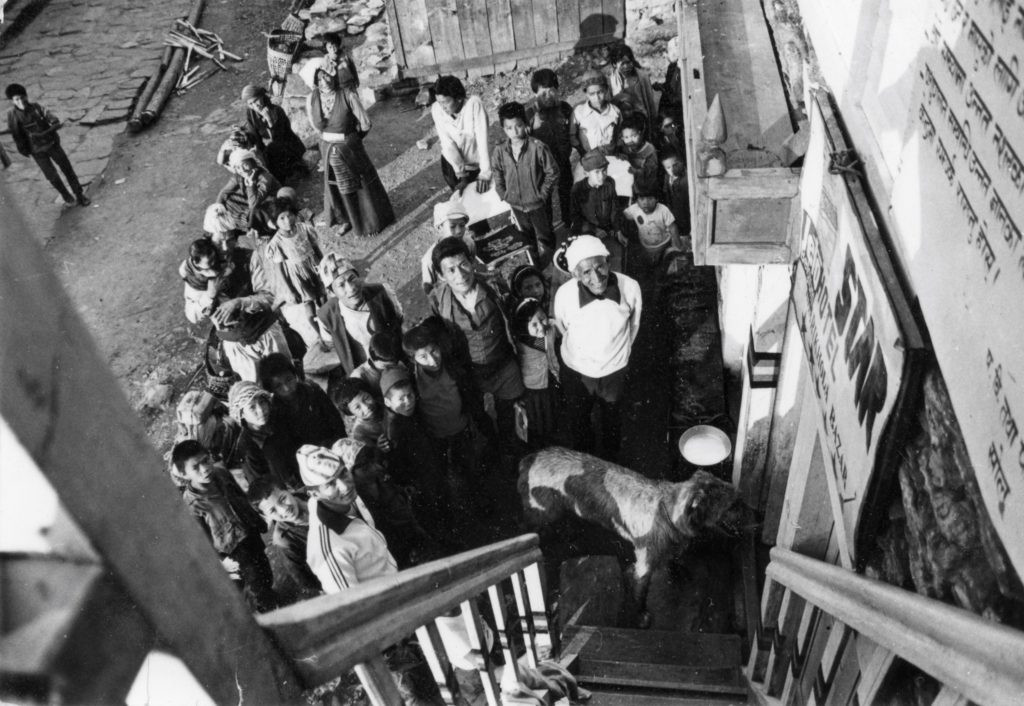
Most of the porters we met read with great difficulty. Instead of saving time, the shirt drew them closer. A group would gather around me, pointing at the letters and sounding out the words together.
Eventually someone would decipher the first line.
Kukur ho.
It’s a dog.
There would be vigorous nodding and congratulations for whichever member of the group had guessed correctly. The usual first guess was goat.
The shirt had another unexpected consequence. The people who stopped to read it were all walking faster than we were. By the time we reached the next village, everyone already knew about the enormous foreign dog.
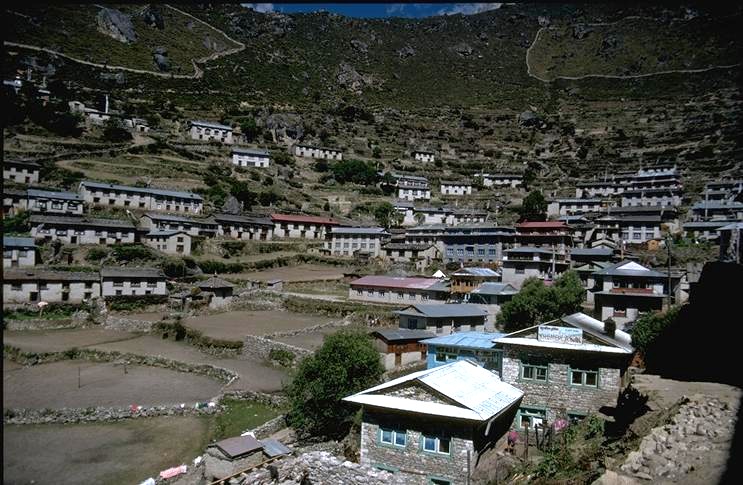
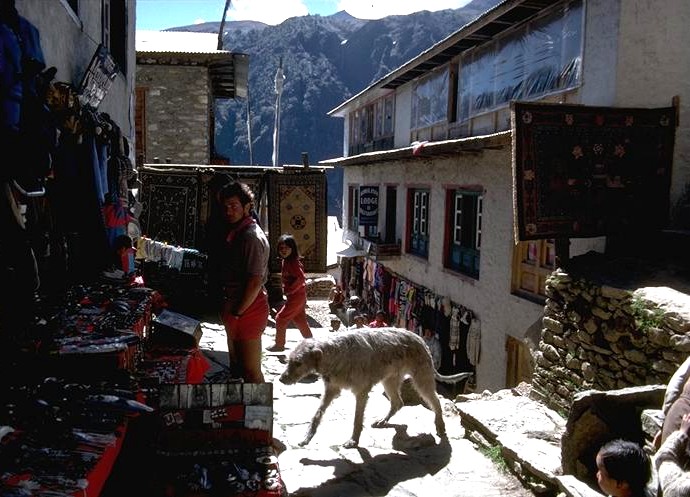
Finally, aften ten days on the trail, we were back in Namche Bazar, one of my favorite places on Earth. There’s a sign at the entrance reading, “Come first as a visitor. Come again… as a friend!” This was not my first or second visit, and we were welcomed as family.
The strangest moment came as we were leaving Namche Bazaar itself. Kids began calling out,
“There it is! Namche! Namche!”
“Goodbye, Tengboche!”
I stopped at the little grocery shop of my friend Tsedam and asked why everyone was suddenly calling her Tengboche. They had known perfectly well all week that her name was Namche.
He looked at me as though the answer were obvious.
“Oh… don’t you call her after the next town you’re visiting?”
I’ve never forgotten that conversation.
Recently it gave me an idea for Sunrise Pashmina.
A pashmina can provoke questions too. What is it? Where is it from? Is pashmina different from cashmere? Can I touch it? How do you wash it?
Perhaps every shawl should come with little cards for the owner to pass out to questioners:
Yes, it’s a pashmina.
Some people call it a “ring shawl” because a fullsize shawl can pass easily through a woman’s ring.
It was handwoven in Nepal.
Pashmina is cashmere: the fine undercoat of domestic goats.
Yes, you can hand-wash it.
Yes, you can touch it—if your hands are clean.
And perhaps, somewhere at the bottom:
I could tell you how much I paid, but then I’d have to kill you.
Leave a Reply