
Nepal’s Five-Year Pashmina Plan Meets Reality

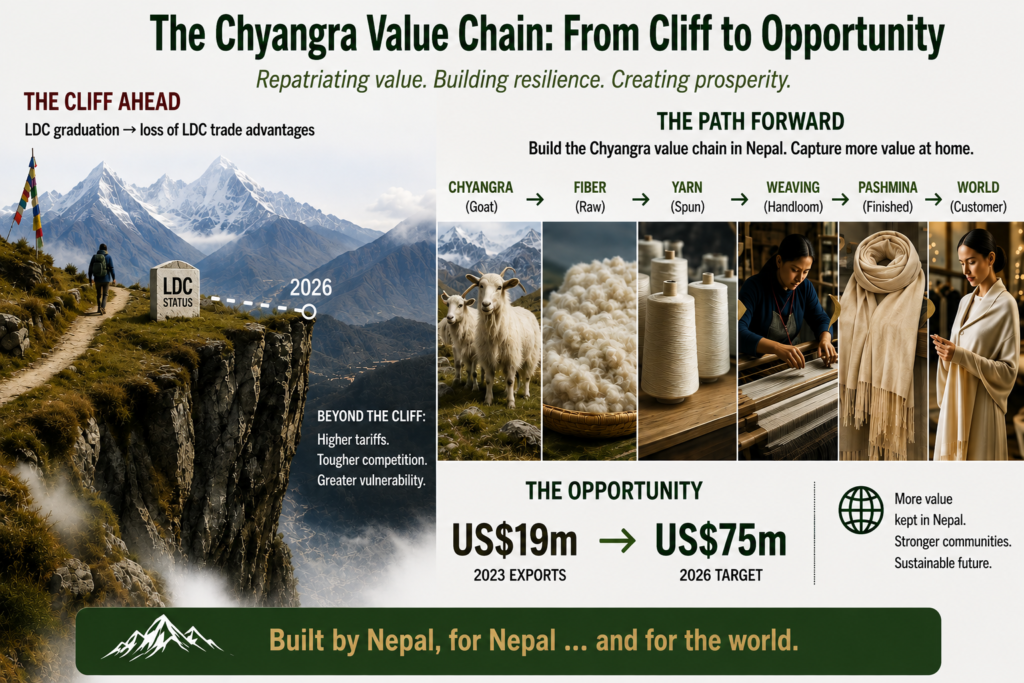
There has been a good deal of nervous chatter lately about Nepal’s pashmina industry, much of it surrounding the National Pashmina Sector Export Strategy 2022–2026, developed by the Government of Nepal with support from the International Trade Centre and the European Union. The attention can seem disproportionate. Pashmina is an established Nepali export, but hardly the foundation of the national economy. Even the strategy’s ambitious target of US$75 million in annual exports would remain small in macroeconomic terms.
The strategy, however, was conceived at an unusually anxious moment. Nepal was still absorbing the consequences of the 2015 earthquakes when COVID-19 demonstrated just how abruptly the economic engine of tourism could screech to a halt. The vulnerability extends beyond hotels, guides and airlines. Revenue from mountaineering permits, particularly for Mt. Everest, supports the institutions and activities through which Nepal manages mountain tourism and conservation. When a climbing season disappears, therefore, the consequences reach beyond the immediate loss of visitors: money that Nepal counts on for administration and stewardship simply vanishes into thin air.
More generally, a succession of environmental hazards, development failures and political shocks has exposed the vulnerability of both mountain communities and the national economy. For Nepal the consequences propagate quickly: disaster—or simply the perception of danger—can cause tourism revenue to flat-line; losses propagate through businesses and households; public and institutional resources shrink at precisely the moment they may be most needed; economic distress increases political pressure; and political instability can further discourage those visitors and investment on which recovery depends. Economic diversification, in this context, is not simply a development aspiration. It is a form of national risk management.
Tourism provides an obvious place to start. Nepal already succeeds in bringing large numbers of international consumers into the country, but appears to capture remarkably little of their potential spending. The problem is therefore not simply how to attract more visitors, but how to increase the value generated by those already there. Shopping offers an unusually attractive opportunity. A visitor can spend another hundred dollars on a locally produced object without requiring another hotel room, another flight or another day in the country. And the economic value of the purchase need not end at departure. A shawl, piece of jewelry or other distinctive object travels home with its buyer, where it can become a gift, a conversation and an advertisement for Nepal. Shopping is simultaneously expenditure, export and word-of-mouth marketing.
Yet Nepal does not appear to collect the kind of detailed international-visitor expenditure data needed to measure that opportunity confidently. For years I have urged the Nepal Tourism Board to institute a simple visitor exit survey, accessible by QR code at departure and designed to accept as much or as little information as travelers wished to provide. It could collect basic demographic and itinerary information, expenditures by category, and assessments of the best and worst aspects of the visitor experience. It could also ask whether departing visitors would be willing to assist Nepal in the event of a future natural disaster and invite them to opt into periodic communications about developments, opportunities and products in Nepal. The point would not simply be to collect better statistics. In tourism as in other businesses, the visitor who leaves satisfied should not become a lost customer. Repeat visits, subsequent purchases and recommendations to friends can make an existing relationship far more valuable than another round of expensive customer acquisition. An exit survey could therefore become the beginning, rather than the end, of Nepal’s relationship with its visitors.
The LDC Graduation Cliff
Then there is the looming commencement day. Nepal is scheduled to graduate from the United Nations category of Least Developed Countries on November 24, 2026. Officially, and genuinely, this is a significant achievement, but one accompanied by considerable trepidation regarding the imminent loss of the preferential arrangements associated with LDC status. In May 2026 the government formally requested that graduation be postponed until November 2029. The UN Committee for Development Policy concluded that an extension would be likely appropriate, but a final determination remains with the General Assembly. (Government of Nepal, Ministry of Foreign Affairs, 2026; United Nations Committee for Development Policy, 2026.)
Put these pressures together and the enthusiasm surrounding pashmina becomes easier to understand. Nepal needs economic resilience. That creates an appetite for magic.
And pashmina can look almost magically well-suited to the occasion.
Pashmina has an unusual advantage in both export and tourist markets: a great deal of value can be concentrated in a very small package. A shawl weighing only a few hundred grams can embody substantial value in fiber, labor, design and craftsmanship. For a visitor, it can represent a significant additional expenditure without requiring another night, another excursion or even much room in a suitcase. The opportunity becomes particularly interesting when visitors are contemplating holiday gift-giving: a single traveler may be shopping not merely for one personal souvenir, but for family, friends and colleagues back home. For an exporter, the same product can be shipped halfway around the world at a tiny fraction of its retail value. And unlike most tourist expenditures, the purchase travels home. Worn, displayed or given as a gift, it becomes an object of show-and-tell—extending the economic and promotional value of the original visit long after the traveler has left Nepal.
But exports and tourist sales are only part of the reason pashmina matters. The more consequential question arises in Mustang, far from Kathmandu’s weaving workshops, where the Chyangra goat and its valuable undercoat have become symbols of a much larger development ambition.
Effective stewardship of Nepal’s remote mountain ecosystems is difficult to sustain without economic opportunity for the people who live in and around them. Conservation cannot indefinitely depend on asking mountain communities to protect landscapes for the benefit of visitors, downstream populations, or an abstract global environmental interest. Communities need livelihoods, services, education and credible economic futures. The connection between conservation, local livelihoods and sustainable development is increasingly central to conservation policy in Nepal and elsewhere. (World Bank, 2024.)
For decades, tourism has supplied much of that economic rationale.
Tourism, Stewardship and the Diversification Problem
Few countries have been transformed by mountain tourism as dramatically as Nepal. Trekking and mountaineering brought international visitors—and international money—into regions that had previously been economically peripheral. Trails became commercial corridors, and roads were paved where no wheels had never been seen. Lodges, restaurants, guiding services, transport companies and equipment suppliers appeared. Tourism created markets for agricultural products and handicrafts and connected remote communities more closely to Kathmandu and the outside world.
The effects did not stop at the trailheads. Nepal’s mountain attractions work synergistically with the cultural amenities of Kathmandu, Pokhara and other gateways. Hotels, restaurants, airlines, trekking agencies, shops and a host of ancillary businesses grew around the movement of visitors through the country. Before the COVID-19 pandemic, travel and tourism supported an estimated one million direct and indirect jobs in Nepal and generated an estimated 7.9 percent of GDP when indirect effects were included. (World Bank, Sustainable Tourism Enhancement of Nepal’s Protected Areas, 2020.)
Tourism has also proved remarkably adaptable. A destination originally known for mountaineering can develop cultural tourism, wildlife tourism, wellness and yoga tourism, culinary tourism, and a broad range of adventure tourism including cycling, paragliding, bungie, extreme marathon, and of course luxury travel. Gateway communities can reinvent themselves as the interests and expectations of visitors change.
That adaptability, however, should not be confused with invulnerability. Nepal has repeatedly experienced the susceptibility of tourism to events over which destinations and individual businesses have little control. The 2015 earthquakes sharply disrupted the sector. COVID-19 did so again on a much greater scale. More recently, political disturbances and disruptions to international aviation have again demonstrated how quickly external shocks can affect arrivals. (World Bank, 2016; World Bank, 2020; World Bank, 2026.)
Climate change introduces additional uncertainty. Meanwhile, successful destinations can face problems created by success itself—congestion, waste, pressure on infrastructure and natural resources, and conflicts between residents’ quality of life and visitors’ expectations. Everest has become perhaps Nepal’s most visible example of the environmental and management challenges that can accompany concentrated tourism. (Associated Press, 2025.)
The familiar ethic of “leave no trace” has never been an adequate stewardship policy for an entire national economy. At best, it asks individual visitors to reduce the damage they cause. It does not answer the larger question of how communities can prosper while conserving the natural and cultural assets on which tourism depends. Nor is perpetual growth in visitor numbers necessarily the answer. Around the world, the phenomenon now commonly referred to as overtourism has forced destinations to reconsider the assumption that more visitors automatically represent greater success.
Diversification is therefore not an argument against tourism. It is an argument for making the communities that depend upon tourism—and Nepal itself—less vulnerable. The challenge is to find complementary economic activities suited to Nepal’s unusual geography.
And that is where pashmina becomes interesting.
An Almost Implausibly Suitable Product
Consider the characteristics one might specify if designing an export industry for a mountainous, landlocked country. The product should have high value and little weight. It should reward skilled labor more than mechanized mass production. It should permit substantial value to be added after the raw material is produced. It should have an international market and a plausible connection to the identity of the country. Ideally, at least some of its value chain should extend into mountain communities rather than being confined entirely to urban industrial zones.
Pashmina appears to tick nearly every box.
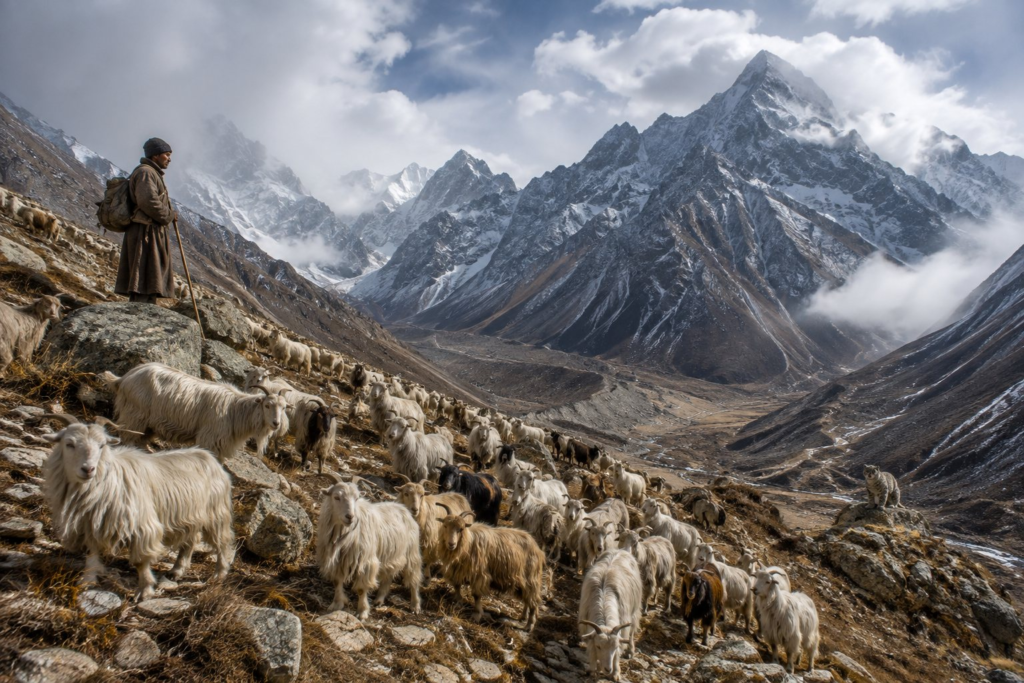
The raw material is the extraordinarily fine down produced by goats adapted to cold, high-altitude environments. Nepal’s Chyangra goats are raised in Himalayan and trans-Himalayan districts where economic alternatives are limited. The strategy identified 15 high-mountain districts as having potential for Chyangra rearing and estimated the national Chyangra population in 2020 at somewhere between roughly 112,000 and 143,000 animals. (NPS Export Strategy, 2022; Prasain, Kathmandu Post, 2023.)
The fiber can be collected in the mountains, while subsequent stages—sorting, dehairing, spinning, dyeing, weaving, finishing, design, marketing and distribution—can potentially generate progressively greater value elsewhere in the country. The finished product is light, durable, internationally recognized and potentially very valuable.
Better still, Nepal already has a pashmina industry.
Kathmandu producers have decades of experience manufacturing shawls, scarves, blankets and related products. Nepali firms sell internationally, and both handlooms and power looms are used in production. The Trade and Export Promotion Centre identifies pashmina yarn and silk yarn as the principal textile inputs, followed by processes including weaving, dyeing, finishing, fringing, embroidery and printing. (Trade and Export Promotion Centre, “Pashmina Products.”)
On paper, the opportunity looks extraordinary.
There is, however, a complication that tends to disappear in promotional descriptions of the sector. Nepal’s existing pashmina manufacturing industry and Nepal’s emerging Chyangra-fiber industry are not the same thing.
The Trade and Export Promotion Centre states explicitly that Nepal’s pashmina manufacturers import their pashmina and silk yarn from China and India. Government material elsewhere acknowledges Mongolia as the world’s second-largest producer of cashmere—estimated at about 20 percent of global production—but does not identify Mongolia as a significant direct source of yarn for Nepal. (Trade and Export Promotion Centre, “Pashmina Products”; Government of Nepal, Products from Nepal.)
The goats may be Himalayan in the imagery surrounding the product, but the fiber passing through a Kathmandu loom need not have come from a Nepali goat—or even have entered Nepal as raw fiber. The manufacturing sector developed without a fully integrated domestic supply chain.
This is not necessarily a defect. International specialization is normal. A country does not have to produce every input used by its manufacturers, and imported yarn can be excellent yarn. But it creates a very different development problem from the one suggested by the simple phrase “Nepal’s pashmina industry.”
There are really three overlapping projects: strengthening an existing textile-manufacturing industry; creating a commercially viable domestic Chyangra-fiber industry; and connecting the two. Behind all three lies a larger question: What exactly is Nepal trying to accomplish?
The Five-Year Dream
The National Pashmina Sector Export Strategy 2022–2026 offered an unusually ambitious answer.
Developed through consultations involving the Ministry of Industry, Commerce and Supplies, the Trade and Export Promotion Centre, the Nepal Pashmina Industries Association and other stakeholders, with European Union funding and technical support from the International Trade Centre, the strategy envisioned a substantially more integrated and competitive pashmina sector. (EU Delegation to Nepal, 2023.)
Chyangra-fiber production would increase. Backward linkages would be strengthened. Harvesting and processing capacity would be developed. Productivity and manufacturing efficiency would improve. Exporters would gain better information about international markets. Certification and traceability would help establish what products actually contained and where their raw material came from. The collective Chyangra Pashmina trademark would be promoted under a code of conduct. (NPS Export Strategy, 2022, pp. 4–6.)
The headline ambition was striking: exports worth US$75 million by the end of 2026. At the strategy’s launch, the EU and ITC reported that Nepal had exported approximately US$19.31 million worth of pashmina shawls in 2021. (EU Delegation to Nepal, 2023; International Trade Centre, 2023.)
It is easy, in retrospect, to treat such a target as merely another optimistic number in a development document. That would be a mistake, because behind the number was a theory of development. Nepal possessed a valuable indigenous raw material, a manufacturing industry capable of transforming pashmina into high-value products, and a national identity unusually compatible with the product. What was missing was the connective tissue: greater fiber production, processing, testing, skills, traceability, branding and access to international markets. Build those links, the reasoning suggested, and Nepal could capture a much larger portion of the value chain.
It is an appealing vision—appealing enough that I initially evaluated many of the sector’s problems in much the same way. Imported yarn looked like dependence. Domestic dehairing and spinning looked like obvious forms of value addition. Counterfeit “pashmina” suggested the need for stronger enforcement of the Chyangra Pashmina collective trademark. The torrent of cheap products sold to tourists suggested an opportunity to pivot toward international consumers interested in quality, provenance and what has come to be called “slow fashion.” Those propositions even found their way into the abstract for a paper I proposed on the subject.
Then I began looking more closely, and the questions became less comfortable.
How much Chyangra fiber can Nepal realistically produce? What happens to mountain landscapes if production expands substantially? Can Nepal dehair and spin cashmere at internationally competitive quality and cost? If excellent yarn can be imported, is replacing it necessarily desirable? Can manufacturers reliably determine what the yarn they buy actually contains? Who in Nepal can test it? What does the Chyangra Pashmina trademark actually certify, how is compliance verified, and does its putative traceability create market value that consumers recognize and will pay for?
More fundamentally, why should a customer in New York, Istanbul, Paris or Tokyo choose a Nepali pashmina at all? “Authenticity” is not an adequate answer. Neither is the Himalaya. A beautiful story can add value to an excellent textile; it cannot indefinitely substitute for one.
The available results, however, give little indication that the export target will be met. The strategy was launched against a 2021 export figure of approximately US$19.31 million in pashmina-shawl exports in 2021 and set a target of US$75 million by the end of 2026. Yet the Nepal Pashmina Industries Association reports export revenue of only about US$15 million in fiscal year 2023/24. The figures may not be constructed on precisely identical statistical bases, and the strategy still has several months to run. But there is no evident trajectory from roughly $19 million toward $75 million. (European Union Delegation to Nepal, 2023; Nepal Pashmina Industries Association, n.d.)
With the strategy now approaching the end of its term, however, the most useful question is not simply whether Nepal will achieve its export target. It is whether the model behind that target survives contact with reality.
The dream was not necessarily too ambitious. It may not have been ambitious enough.
Building the Chain
The National Pashmina Sector Export Strategy did not emerge from nowhere. Pashmina had already been identified as a priority export sector under Nepal’s Trade Integration Strategy 2016 and Commerce Policy 2015. The new strategy was developed through repeated multi-stakeholder consultations among government, industry and development partners. (NPS Export Strategy, 2022; EU Delegation to Nepal, 2023.)
Its vision was succinct: “Contribute to achieve national prosperity through increased and sustainable export of Chyangra Pashmina from Nepal.” (NPS Export Strategy, 2022, p. 4.)
The strategy divided that ambition into four objectives: increasing Chyangra Pashmina fiber production and developing backward links; increasing the sustainable productive capacities of pashmina producers; increasing exports of Chyangra Pashmina products from Nepal; and strengthening institutional and policy support for their promotion and export. (NPS Export Strategy, 2022, p. 4.)
There is a logic to the sequence. It begins with the goat and ends with the international customer. In between, it attempts to build the missing chain.
Back to the Goat
The first problem was obvious. If Nepal wished to sell increasing quantities of products whose distinctive identity rested on Nepali Chyangra pashmina, it needed more Nepali Chyangra fiber.
That meant increasing fiber production and productivity, improving husbandry and harvesting, and making the fiber itself more valuable to the farmer. It also meant creating stronger commercial connections between remote producers and the manufacturers who could ultimately transform their fiber into expensive finished goods. (NPS Export Strategy, 2022, pp. 5–6.)
This is the “backward linkage” that appears repeatedly in the strategy and in the development work surrounding it. Nepal already possessed manufacturers and exporters. The proposed intervention would extend the economic chain backward from Kathmandu toward the high-mountain districts where Chyangra are raised.
Mustang was to serve as a model. The strategy proposed modern tools and equipment at the local level, technical support, certification and traceability, and specifically called for lessons from Mustang to be disseminated to other fiber-producing districts. (NPS Export Strategy, 2022, p. 6.)
The intended result was not simply more goats. It was a different relationship between the goat herder and the luxury textile. A farmer selling an undifferentiated bag of raw fiber at whatever price a trader offered occupied the weakest end of the chain. A farmer producing identifiable, properly harvested, quality-controlled Chyangra fiber for a known market occupied a potentially stronger one.
That distinction matters enormously if pashmina is expected to contribute to mountain livelihoods rather than merely decorate them in advertising.
The Missing Middle
Increasing fiber production, however, would accomplish little if Nepal could not transform the fiber into something its manufacturers could use.
Raw cashmere is not yarn. The fine undercoat collected from a Chyangra goat is accompanied by coarser guard hair and other material. It must be sorted and cleaned, and the valuable down separated from the coarse fibers through dehairing. Only then can it move through the further processes required to become usable yarn.
This was one of the conspicuous gaps in Nepal’s value chain. Nepal could raise Chyangra goats and weave pashmina shawls, but between those activities lay processing and spinning capabilities that had largely been supplied from outside the country. Nepal’s own Trade and Export Promotion Centre describes the industry as dependent on imported pashmina yarn. (Trade and Export Promotion Centre, “Pashmina Products.”)
The strategy therefore sought not merely to improve the efficiency of Nepal’s pashmina processing and manufacturing sector in general, but actually to build the missing domestic links in the value chain, including Chyangra fiber harvesting and processing centers. (NPS Export Strategy, 2022, pp. 4–6.)
The symbolism of this objective became concrete on February 7, 2023, when the strategy was formally launched and the foundation stone was laid for a planned Pashmina Fibre Processing Centre at Harisiddhi in Lalitpur. The EU described the center as a means of connecting Chyangra farmers and traders, improving market prospects and establishing a basis for quality fiber production. (EU Delegation to Nepal, 2023.)
The idea was compelling: instead of underutilizing Nepali raw fiber while Kathmandu manufacturers depended on imported yarn, Nepal could connect the two ends of its own industry. Fiber from a Chyangra in Mustang could become yarn in Nepal and eventually a shawl woven in Kathmandu. More of the value could remain inside the country.
Keeping more processing in Nepal does not, however, make that processing environmentally neutral. Cleaning, dehairing, dyeing and finishing require water and energy and can generate wastewater and solid residues. If domestic processing is to count as a stewardship gain rather than simply a transfer of production from one country to another, its resource use and waste streams belong in the accounting too. The strategy’s public environmental case has much more to say about the provenance of the fiber than about the environmental performance of the facilities that process it.
Or so the theory went.
The distinction between creating more value and performing more stages of production domestically will become important later. They sound very much like the same thing. They are not.
From Production to Productive Capacity
The strategy did not reduce competitiveness to machinery. Its second strategic objective called for increased efficiency in processing and manufacturing as well as for improvements in the design and quality of Chyangra Pashmina products. Its wider implementation framework emphasized the capacities of enterprises and trade-support institutions. (NPS Export Strategy, 2022, p. 4; EU Delegation to Nepal, 2023.)
This is an important part of the plan because Nepal’s competitive advantage could never plausibly rest on mass production alone. China and India possess textile industries of a scale Nepal cannot approach. Nepal therefore needs to compete differently. Its advantages would have to come from some combination of quality, specialization, flexibility, craftsmanship, design, provenance and the ability to turn a relatively small amount of exceptionally valuable material into an exceptionally desirable product.
That requires more than fiber. It requires knowledge.
The strategy recognized parts of this problem, although the importance of knowledge may ultimately extend considerably beyond the forms of training envisioned in a conventional value-chain development program.
Knowing What It Is
Quality creates another problem: someone has to be able to establish it.
Pashmina is particularly unforgiving in this respect because many characteristics that determine the commercial value of cashmere cannot be reliably established by looking at a finished shawl—or even by feeling one. Fiber diameter matters. Fiber composition matters. The presence of coarse or substitute fibers matters. Yarn characteristics matter. And origin matters if origin is going to be used as part of the product’s identity.
The strategy consequently called for a Chyangra Pashmina fiber certification and traceability system, modern equipment at the local level and a certification scheme extending to the end product. (NPS Export Strategy, 2022, p. 6.) These were not peripheral bureaucratic exercises. They were necessary to the larger promise represented by the words Chyangra Pashmina.
Traceability was supposed to connect the finished article backward through processing to the fiber from which it had been made. Certification could provide evidence that claims attached to a product corresponded to something measurable. This becomes particularly important in a market in which the word pashmina has been applied with extraordinary freedom.
The strategic response was not merely to make better products. It was to make their identity more knowable.
Here again, however, a larger question waits in the background. A traceability system can tell us where something came from; a laboratory can tell us what something contains; and a trademark can tell us that specified rules have been followed.
None of those things, by itself, tells a customer that the resulting shawl is beautiful.
Giving Chyangra a Name
The collective trademark Chyangra Pashmina occupied a prominent place in the strategy, but its origins predate it. Nepal had earlier sought international protection for Pashmina as a collective trademark, leading to a protracted dispute with India, which asserted Kashmir’s much older association with the term. Nepal was unsuccessful in securing exclusive rights to Pashmina alone. It subsequently adopted the collective mark Chyangra Pashmina, combining the Nepali name for its pashmina-producing goat with pashmina to create a commercially protectable compound name. The mark was intended to distinguish qualifying Nepal-made products and provide putative assurance of provenance and quality.
The 2022–2026 strategy explicitly called for promotion of the Chyangra Pashmina trademark with strict adherence to its code of conduct. (NPS Export Strategy, 2022, p. 4.) The Nepal Pashmina Industries Association states that the label is to be used only on products meeting its quality standards and requires members to follow its manufacturing and fiber-composition criteria. (NPIA, “Lab Testing and Code of Conduct.”)
That requirement is crucial. A trademark has value only to the extent that customers learn what it means and have reason to trust it. Registration can protect a mark legally; it cannot manufacture reputation.
The strategy therefore coupled identity with market promotion. Nepal was not merely to make Chyangra Pashmina. It had to persuade the world to want it.
Finding the Customer
The third strategic objective moved decisively outward: increase exports. Exporters were to receive better information about foreign markets and trends, while market promotion and trade connections were to be strengthened. (NPS Export Strategy, 2022, p. 4.)
The third strategic objective moved decisively outward: increase exports. Exporters were to receive better information about foreign markets and trends, while market promotion and trade connections were to be strengthened. (NPS Export Strategy, 2022, p. 4.)
As noted above, the strategy envisioned a dramatic increase in pashmina exports by the end of 2026.
To reach that target, Nepal would have to expand dramatically in markets where Nepali pashmina was already competing with established international luxury brands and with less expensive products from manufacturers around the world. The question was therefore not simply whether Nepal could make more pashmina, but why customers abroad should choose Nepal’s.
Making the Pieces Work Together
The fourth objective addressed a less glamorous but indispensable part of the problem: institutions. A national value chain involving pastoralists, collectors, processors, manufacturers, exporters, trade associations, laboratories and several levels of government does not assemble itself.
The strategy therefore proposed stronger institutional and policy support and an implementation mechanism coordinating the organizations responsible for different parts of the plan. The development process itself was explicitly multi-stakeholder, bringing together government agencies, the pashmina industry and development partners. (NPS Export Strategy, 2022; EU Delegation to Nepal, 2023.)
This may be the least visible part of the dream, but perhaps the most ambitious. The strategy was attempting to turn a collection of related activities into a system. The goat farmer in Mustang, the fiber processor in Lalitpur, the weaver in Kathmandu, the exporter, the testing and certification apparatus, the Chyangra Pashmina trademark and the overseas buyer were all supposed to become parts of the same economic story.
That is why the metaphor of the value chain is so powerful. Each link strengthens the next; each transformation adds value. If the chain can be anchored at both ends—among mountain producers at one end and affluent international consumers at the other—some portion of the wealth created in global luxury markets can travel backward toward communities with comparatively few economic alternatives.
For a country seeking simultaneously to diversify exports, strengthen manufacturing and create opportunity in remote mountain regions, the proposition is enormously attractive.
It is also unusually testable. The strategy supplied objectives, interventions and institutions and, most conveniently for anyone looking back at it now, it supplied a date: 2026.
We have arrived. So what happened?
Strategy Meets Reality
Five-year strategies invite a particular kind of retrospective. The temptation is to compare the promised number with the achieved number, declare success or failure, and move on.
That would be too simple here.
The US$75 million export target certainly matters. At the strategy’s launch, the EU and ITC reported Nepali pashmina-shawl exports of approximately US$19.31 million in 2021. Reaching US$75 million by the end of 2026 would therefore require something approaching a fourfold increase. Other program documents, however, have used starting figures closer to US$27 million or US$30 million. The discrepancy may reflect different product categories, fiscal years or definitions, but it illustrates an awkward problem: a numerical target is less informative when the baseline against which it is measured is uncertain.
More importantly, the strategy was never merely an export forecast. It was a proposal to build a different pashmina economy. Judging it therefore requires looking at what happened to the proposed chain: the goats and fiber at one end; collection and processing; manufacturers and their imported inputs; testing, certification and traceability; and finally the international customer.
On that broader measure, the record is considerably more interesting than either “success” or “failure” suggests.
Something Really Was Built
The easiest mistake would be to treat the strategy as another development plan that produced reports, workshops and aspirations but little physical change.
That is not what happened.
A pashmina fiber-processing facility at Harisiddhi in Lalitpur, whose foundation stone was laid when the strategy was launched in February 2023, was inaugurated in May 2024. A de-dusting facility subsequently opened at Lo Manthang in Upper Mustang. Training and fiber-collection programs were expanded; combing equipment was distributed to farmers; and the program reported increased fiber collection and substantially higher prices paid to producers. ITC later reported that approximately 1,300 combing machines had been distributed, production had increased by roughly one-third, farmers were receiving prices around 80 percent higher, and two additional tonnes of fiber were sold in 2024. (International Trade Centre, 2024–2025.)
The program also worked farther down the chain. An export guide was produced for markets including Japan, the European Union, the United States and the United Kingdom. Training and institutional development continued. Farmers in Mustang were brought more directly into the emerging processing structure, including through ownership participation.
These are real accomplishments. They matter particularly because one of the weaknesses of development planning is the ease with which a “value chain” can remain a diagram. Here, some of the missing links became actual machinery, organizations and commercial relationships.
But the scale of what was built is equally important.
The processing facility has been reported as capable of handling only several tonnes of raw fiber annually. That sounds surprisingly small beside a national export ambition of US$75 million—until one examines the underlying fiber arithmetic.
How Much Pashmina Is There?
The 2022 ITC technical study Pashmina Fibre Transformation in Nepal, prepared by S. H. Lee and G. Jha, attempted to answer a question that promotional discussions of Chyangra Pashmina can easily glide past: how much usable Nepali pashmina fiber actually exists?
The answer is: not very much.
A Chyangra goat produces only a small quantity of commercially useful fine undercoat. The technical study modeled several collection scenarios using an estimated national Chyangra population of roughly 131,000 animals. Even if fiber were harvested from half of them, the study estimated annual production of only about 13.17 tonnes of greasy pashmina fiber. (Lee and Jha, Pashmina Fibre Transformation in Nepal, 2022.)
And greasy fiber is not the material that enters a spinning machine.
Cleaning and dehairing remove dirt, grease, coarse guard hair and other material. Each stage reduces the weight. The amount of fine, spinnable cashmere emerging from 13 tonnes of raw fiber is therefore considerably smaller.
This calculation led the ITC consultants to an important conclusion: Nepal did not have enough domestic fiber to justify investment in industrial-scale spinning. They estimated that approximately 30 tonnes would be required even for relatively small industrial spinning equipment and recommended a much more modest processing approach appropriate to the quantities actually available. (Lee and Jha, 2022.)
This is one of the most useful findings in the entire five-year exercise, partly because it resists the grander story the strategy could easily have told.
Nepal can increase collection. It can improve the quality of harvested fiber. It can pay farmers more. It can de-dust, sort and dehair more fiber domestically. It may eventually develop specialized spinning capacity.
But the numbers do not support the idea that Nepal can simply replace the large volume of imported cashmere yarn used by its existing manufacturing sector with fiber from its present Chyangra population.
That need not be a problem. It becomes a problem only if domestic self-sufficiency is mistaken for the objective.
The Goat Is Not a Factory
It is easy to look at the fiber calculation and reach for the obvious solution: if Nepal does not have enough fiber, increase the number of goats.
That is precisely where an industrial value-chain model becomes dangerous.
A machine can, within limits, be duplicated when additional output is required. A pastoral ecosystem cannot. Chyangra goats require land, forage, water, labor, veterinary care and protection from weather and predators. Their production occurs within mountain landscapes that support other livestock, wildlife and human uses. Increasing the number of animals therefore changes something much larger than the fiber supply.
The relevant measure of success cannot simply be kilograms of pashmina.
Nor should the environmental argument be reduced to the equally simplistic proposition that goats are intrinsically destructive. Much of the international discussion of cashmere has been shaped by Mongolia, and for good reason. Following the economic changes of the early 1990s and rising international demand for cashmere, livestock numbers increased dramatically and the proportion of goats rose sharply. Mongolia has since experienced land degradation and desertification on an enormous scale. Climate change is an important part of the explanation, and researchers disagree about the extent and causes of degradation in particular places, but heavy grazing pressure—including the expansion of cashmere-goat herds—is widely recognized as a major contributor. (UNDP, 2021.) Mongolia therefore provides more than a rhetorical caution about goats: it demonstrates how international demand for a valuable animal fiber can interact with pastoral incentives, weak limits and climate stress to transform landscapes. That experience deserves attention, but it is a warning rather than a ready-made model for Nepal.
The correct question is empirical: how much livestock pressure can particular Nepali rangelands sustain, under what forms of management, and with what consequences for vegetation, soils, wildlife and pastoral livelihoods?
The five-year strategy says surprisingly little about the ecological ceiling.
That omission matters because a program explicitly intended to increase the benefits reaching Chyangra farmers in remote mountain regions can undermine its own purpose if greater demand for fiber encourages herd expansion beyond sustainable levels. Conversely, a program that increases the value of fiber already produced by existing animals may improve household income without requiring comparable expansion in animal numbers.
Those are radically different development models.
For mountain stewardship, the preferred direction should therefore be more sustainable value per animal and per kilogram of fiber, not simply more goats.
The Goat Is Part of a System
There is another problem with treating Chyangra production as though it were simply the first stage of an industrial supply chain. The goat is not only a biological rather than mechanical means of production; it is part of a pastoral system.
In much of Nepal’s high mountain region, livestock production has historically depended on some form of seasonal movement, allowing animals to exploit pasture that changes with altitude and season. Research on Nepali transhumant sheep and goat systems has identified shortages of shepherds, restrictions on grazing, degraded pasture, transportation difficulties, animal-health losses and predation among the pressures threatening their continuation. (Pandey and Gyawali, Constraints and Potential of Goat and Sheep Production under Transhumance Management System in the High Mountainous Regions of Nepal.) More recent work on high-mountain livestock enterprises likewise identifies limited pasture, inadequate veterinary services and weak market connections as significant constraints. (Khadka and Thapa, 2020.)
This makes the labor question considerably more important than the pashmina strategy sometimes makes it appear. The 2022 ITC technical report itself notes the difficulty farmers face in finding herders as younger people seek opportunities elsewhere. That should not be interpreted simply as a shortage to be corrected through training or awareness. It may be a price signal from the labor market. Herding competes with education, migration, tourism, commerce and other forms of employment for the same people’s time. If a development strategy depends upon young people performing difficult work that they have good reasons not to want, the cost of persuading them to do it belongs in the economics of the strategy.
The economics become still more interesting when fiber is considered alongside the animal’s other uses. The ITC consultants report that meat, rather than pashmina, provides the principal return from Chyangra husbandry. Their field estimates put the value of a male animal at as much as US$400 and a female at US$200, while roughly 200 grams of greasy pashmina fiber at US$40 per kilogram would produce only about US$8 per animal per year. Farmers were also reported to believe that harvesting the fiber could adversely affect animal growth. Whether or not that belief is biologically justified, it affects behavior. A strategy that depends upon substantially increasing fiber collection therefore needs to demonstrate not merely that the fiber has value, but that collecting it is worth the farmer’s time and compatible with the farmer’s more important reasons for keeping the animal. (Lee and Jha, 2022.)
This is where the distinction between technical feasibility and livelihood feasibility becomes useful. The ITC study does a serious job of estimating how much fiber Nepal might collect and what machinery would be appropriate for processing it. What has not been demonstrated nearly as convincingly is whether substantially greater fiber collection is the best use of the pastoral resources on which it depends.
A study of 138 livestock enterprises in ten of Nepal’s mountain districts found Chyangra farming to be economically viable. Its estimated economic returns, however, were lower than those of sheep and ordinary-goat enterprises and were considerably more sensitive to changes in revenue and operating costs.This does not prove that Chyangra fiber development is a bad investment: the enterprises studied were not designed specifically to test the pashmina strategy, and better fiber prices could change the calculation. It does mean that the question cannot be answered simply by observing that Chyangra produce a valuable fiber. Pasture, labor and capital all have alternative uses. A serious development strategy must compare those alternatives. (Khadka and Thapa, 2020.)
There is another complication. Chyangra are not simply fiber-producing animals awaiting either combing or slaughter. They belong to a broader high-Himalayan tradition of multipurpose pastoralism, in which livestock may contribute offspring, milk, manure and transport, as well as fiber, before ultimately acquiring value as meat. Slaughter therefore realizes one source of value while terminating others, and replacement animals do not instantly reproduce the full utility of mature stock. The relevant economic question is not simply whether annual fiber revenue is large or small compared with the eventual sale price of the animal, but how fiber fits into the animal’s lifetime contribution to the household economy. Any serious assessment of herder incentives therefore requires something closer to life-cycle accounting than a simple comparison between pashmina and meat.
Transhumance makes the ecological calculation equally complicated. Seasonal grazing systems distribute animals through space and time; changing herd numbers, migration routes or access to pasture can therefore have effects that cannot be inferred from the number of goats alone. Nor is it safe to import simple lessons from Mongolia, Ladakh or Tibet and assume that they describe Mustang. The familiar claim that cashmere goats necessarily destroy rangelands is no more satisfactory than the opposite claim that traditional Chyangra husbandry necessarily promotes stewardship.
The relevant questions are local: where animals graze, at what densities, in which seasons, alongside which other livestock and wildlife, under what system of pasture management, and with what evidence of change over time.
The ITC strategy is therefore right to avoid assuming that expansion must mean simply multiplying the number of goats. Indeed, the technical report’s own numbers suggest that the more immediate opportunity is to collect a larger proportion of fiber from animals already present and to increase its value. But that creates another empirical question: can collection rates actually rise enough to matter when herding labor is scarce and fiber is a relatively small part of household returns?
The strategy has supplied combs, training, collection arrangements and higher prices, all of which may help. What remains to be demonstrated is how far these measures can change behavior at economically significant scale.
Resilience Has More Than One Meaning
There is a further reason to be cautious about equating domestic production with resilience.
Nepal’s dependence on imported Chinese yarn creates obvious vulnerabilities. Manufacturers must trust foreign suppliers, international transport can be disrupted, and Nepal captures relatively little of the value associated with the raw material. Developing a domestic Chyangra supply therefore creates a useful alternative.
But replacing one source of dependence with another does not eliminate risk. It changes the kind of risk.
Mountain livestock systems are exposed to weather, disease, predation and isolation. The ITC field material itself records serious livestock losses from disease and describes the severe winter conditions under which Chyangra are raised. Independent research on Nepali high-mountain livestock enterprises reports that lack of veterinary services and harsh weather have contributed to business failures. The neighboring Ladakh cashmere system provides an additional warning, although not direct evidence about Nepal: extreme winter events there have demonstrated how quickly geographically concentrated high-altitude livestock populations can suffer catastrophic losses.
This matters because an industrial supply strategy usually assumes that next year’s input can be produced again. A pastoral system offers no such guarantee. A severe winter, forage shortage or livestock epidemic can damage not only one year’s fiber crop but the breeding population from which subsequent production depends.
Veterinary services, disease surveillance, emergency fodder, access to treatment, insurance and household financial resilience are therefore not peripheral social programs added to a pashmina strategy. To the extent that the industry depends upon Nepali animals, they are part of its production infrastructure.
The existence of a livestock insurance system is therefore only the beginning. The relevant questions are whether Chyangra herders actually enroll, what losses are covered, whether claims can be documented under remote mountain conditions, how quickly valid claims are paid, and whether compensation is sufficient to allow a household to rebuild a breeding herd after a correlated disaster. An insurance program that farmers cannot readily use provides little resilience when an entire community is hit at once. (Government of Nepal, Ministry of Agriculture and Livestock Development, 2024.)
The distribution of risk matters as much as its magnitude. A manufacturer whose domestic yarn supply fails can buy imported yarn, perhaps at a higher price. A farmer who loses a substantial part of a herd can lose accumulated capital, current income and future breeding capacity simultaneously. If animals were purchased with debt, the loss can survive long after the goats themselves are gone.
An industry can therefore become more nationally self-reliant while making individual producers more vulnerable. Any claim that backward integration improves mountain livelihoods should ask not only how additional income is divided, but who carries the loss when the system fails.
This leads to a somewhat counterintuitive conclusion. The most resilient Nepali pashmina industry may not be one that eliminates imported fiber or yarn. It may be one that possesses a valuable, well-understood and traceable domestic Chyangra supply alongside access to reliable international materials.
Domestic fiber can then support a distinctive premium product without being required to carry the full weight of Nepal’s manufacturing industry, while imported cashmere allows manufacturers to continue producing when domestic supply is insufficient or disrupted. Diversification, in this case, applies inside the supply chain as well as to the national economy.
That distinction also changes the meaning of stewardship. Stewardship cannot mean maximizing the number of Chyangra, maximizing the quantity of fiber harvested, or even maximizing the percentage of Nepali fiber in Nepali shawls. It means maintaining a pastoral system capable of supporting animals, people and landscapes over time while producing enough economic value to make its continuation worthwhile to the people who actually participate in it.
If that requires fewer animals producing more valuable fiber, imported yarn for much of the manufacturing industry, or allowing some households to leave pastoralism altogether, those outcomes should not be counted as failures merely because they make the value-chain diagram less completely Nepali.
A Domestic Supply Chain—But How Much of One?
The fiber arithmetic changes the meaning of “backward linkage.”
There is a strong argument that Nepal should possess the ability to collect, sort, clean, dehair, characterize and perhaps spin its own Chyangra fiber. Those capabilities create knowledge, bargaining power and options. They allow Nepal to develop products whose domestic provenance can actually be demonstrated. They also create a way for some of the value generated by luxury textiles to reach pastoral communities.
But none of this requires Nepal’s entire pashmina manufacturing sector to abandon imported yarn.
Indeed, trying to do so could create new problems. Nepal’s manufacturers require predictable quantities, specifications, colors and delivery schedules. International yarn suppliers operate at scales that make those things possible. A small domestic fiber industry built around geographically dispersed herds cannot immediately provide the same consistency.
The relevant objective is therefore not autarky but capability.
Nepal should know what its own fiber is. It should be able to process it. It should understand its characteristics and variation. Farmers should have credible markets for it. Manufacturers who want Nepali Chyangra fiber should be able to obtain material with known specifications and provenance.
And manufacturers should remain free to use excellent imported cashmere when imported cashmere is the appropriate input.
This sounds less heroic than “farm to finished shawl, entirely in Nepal.” Economically, it may be considerably stronger.
The Problem of Knowing What You Have
The same realism is needed farther down the chain.
For much of Nepal’s pashmina industry, quality control has historically depended on relationships with yarn suppliers, manufacturer experience and tactile judgment. Experienced producers can learn a great deal by handling yarn and fabric.
But touch cannot establish everything that matters.
It cannot reliably establish fiber diameter. It cannot tell a manufacturer precisely what percentage of a blended yarn is cashmere. It cannot prove geographical origin. It cannot detect every sophisticated substitution. And it cannot provide the documentary evidence required if a premium product is to make increasingly precise claims about composition and provenance.
This problem becomes more serious, not less, as Nepal attempts to differentiate Chyangra Pashmina.
A generic cashmere manufacturer can purchase yarn from a trusted supplier and manufacture to an agreed specification. A manufacturer claiming that a shawl is made from traceable Nepalese Chyangra fiber has taken on a much larger evidentiary burden. Someone must establish which fiber entered the lot, what its characteristics were, what happened during processing, and whether it remained segregated from other material.
The strategy recognized this through its emphasis on certification and traceability. But traceability is only as reliable as the measurements and records on which it rests.
And here the biological nature of the raw material returns.
Cashmere fiber is not uniform simply because it comes from the same breed of goat. Fiber diameter, length and yield can vary with animal, age, sex, nutrition, location, season and other conditions. Research on cashmere goats elsewhere shows substantial age-related differences in commercially important fiber characteristics. Those findings cannot simply be transferred to Nepalese Chyangra, but they demonstrate why Nepal needs its own measurements rather than assumptions.
A single study showing that Chyangra fiber has an attractive average diameter would therefore be useful science but inadequate quality control. Manufacturers do not weave averages. They weave lots of yarn produced from particular lots of fiber.
If Nepal wants to sell measurable quality, the measurement ultimately has to follow the material.
That suggests an upstream system of representative sampling and lot testing, accompanied by records that remain connected to the fiber as it moves through dehairing, spinning and manufacturing. Testing finished shawls alone would be expensive, inefficient and, where destructive analysis is required, commercially impractical.
The most important infrastructure may therefore turn out not to be another machine.
It may be knowledge infrastructure: credible laboratories, sampling protocols, trained technicians, reference data, chain-of-custody records, and manufacturers who understand what the results mean.
Without that infrastructure, certification risks becoming another label whose authority rests primarily on trust.
With it, Nepal gains something considerably more valuable than a marketing claim: the ability to know its own material.
What Does Chyangra Pashmina Actually Promise?
Knowing the material is one problem. Communicating that knowledge to a customer is another.
The Chyangra Pashmina collective trademark was designed in part to solve the problem created by decades of indiscriminate use of the word pashmina. In tourist markets in Nepal and elsewhere, “pashmina” has been applied to an extraordinary range of products: pure cashmere, cashmere blends, wool, viscose and synthetic fabrics, as well as mixtures whose composition may be uncertain even to the person selling them.
A collective trademark can help restore order to that confusion. It can establish rules governing who may use the mark and under what conditions. It can require testing, documentation and compliance with a code of conduct. And if consistently enforced over many years, it can acquire reputational value of its own.
But the trademark also introduces a conceptual problem. Chyangra identifies the Nepalese high-altitude goat from which the fiber is supposed to derive. Pashmina, in ordinary international textile usage, is considerably less precise. In the United States, for example, the Federal Trade Commission does not recognize “pashmina” as a separate fiber category. A product may be characterized as pashmina, but its fiber content must be specified using legally recognized fiber names: for example, 70% cashmere, 30% silk. In regulatory terms, then, pashmina says nothing about fiber composition. In the marketplace, however, the word can say—or appear to say—a great deal more.
A customer encountering Chyangra Pashmina may reasonably infer several things at once: that the product contains cashmere; that the cashmere came from Chyangra goats; that those goats were raised in Nepal; that the product was manufactured in Nepal; perhaps even that it was handwoven and produced under particular environmental or animal-welfare conditions.
Those are disparate claims.
A fiber-composition test can address some of them. Traceability can address others. A collective trademark can impose still others as conditions of use. None should be allowed to bleed silently into the next.
This is especially important because the more evocative the name becomes, the greater the temptation to make it carry meanings that have not actually been demonstrated.
The Authenticity Trap
This leads directly to one of the most seductive ideas in contemporary marketing: authenticity.
Nepal seems almost extravagantly endowed with it. The Himalaya, pastoral communities, Chyangra goats, handlooms, inherited craft traditions and Kathmandu workshops provide precisely the sort of material from which luxury brands now construct stories of place, provenance and human connection.
The temptation is therefore obvious. If Nepal cannot compete with China on scale, compete on authenticity.
I have become increasingly skeptical of that formulation.
The first problem is definitional. Authentic what?
A shawl woven in Kathmandu from excellent Chinese cashmere yarn is authentically a Nepalese manufactured textile. It is not made from Nepalese Chyangra fiber. A shawl made from Nepalese fiber but woven on a power loom is authentically made from Chyangra cashmere but is not handwoven. A handwoven shawl may be produced from machine-spun yarn. A handspun yarn may contain fiber gathered from animals whose precise origin is unknown.
None of these products is necessarily inferior to another. They are simply different.
“Authenticity” becomes dangerous when it collapses these differences into a single moral category in which the product closest to an imagined traditional past is presumed to be the most genuine—and therefore the best.
That assumption is not merely historically questionable. It can lead to bad development policy.
Tradition Is Not a Production Specification
There is enormous value in preserving knowledge of traditional textile processes. Hand spinning in particular is not an unskilled preliminary operation that can be recreated merely by distributing spinning wheels. Producing fine, even yarn requires substantial practice and judgment. The long history of spinning is embedded so deeply in language that the English word spinster originally meant simply a woman who spins.
But respect for skill does not require pretending that every traditional process is commercially optimal.
Machine spinning can produce exceptionally consistent yarn. Power looms can produce excellent cloth. Handlooms can produce characteristics, flexibility and small-batch possibilities that machines may not reproduce economically. Each technique has capabilities and limitations.
The useful question is therefore not whether a process is traditional. It is what the process contributes to the finished textile.
If hand spinning creates a yarn with qualities that designers and customers genuinely value, it can become part of a premium product. If hand weaving enables structures, textures, dimensions or short production runs that would otherwise be impractical, that is a competitive advantage. If a particular traditional technique survives primarily because development programs have decided that traditional techniques ought to survive, its economic future is much less secure.
Preservation and commercial development are both legitimate goals. They should not be confused.
The same caution applies to environmental claims. A process is not necessarily sustainable because it is old, local or performed by hand. Nor is a mechanized process necessarily environmentally destructive. Sustainability depends upon energy, water, chemicals, waste, transport, durability, land use and many other factors that have to be measured. Attributing a romantic character to a production system does not establish how that system actually affects the environment.
Animal Welfare Is Not a Slogan Either
The Chyangra story can acquire another attractive layer through claims about animal welfare. Fiber can be collected by combing rather than shearing, and promotional accounts sometimes present this as a particularly humane characteristic of Nepali pashmina production.
Care is needed here as well.
Combing during the natural shedding period may indeed provide a low-stress method of collecting fine undercoat when it is done properly. Training in appropriate harvesting techniques can improve both fiber quality and animal welfare. But the fact that a goat is combed tells us very little about the total conditions under which it lives.
Welfare includes nutrition, shelter, disease prevention and treatment, handling, transport, exposure to extreme weather and what happens when the animal ceases to be economically useful. Chyangra are livestock in an economy in which meat is an important—and according to the ITC technical work, often predominant—source of value. A fiber system should not be marketed as though the goat exists solely to grow a renewable luxury textile.
This becomes particularly relevant as animals age. Research on other cashmere-goat populations indicates that fiber yield and characteristics can change substantially with age. Equivalent longitudinal information for Nepali Chyangra appears to be limited. If older animals produce less commercially valuable fiber while continuing to consume scarce pasture, an economically expanding fiber industry eventually has to confront what happens to them.
There is nothing inherently discreditable about a pastoral system that produces both fiber and meat. What would be discreditable is allowing consumers to infer otherwise because a more sentimental story sells better.
The better principle is simple: make only the welfare claims that the production system can document.
Luxury consumers do not necessarily require a pastoral idyll, and constructing one can be risky. Claims of “no-kill,” “cruelty-free,” or environmentally benign production create promises that may later be contradicted by evidence from the production system itself. The discovery of an ordinary imperfection is then transformed into the exposure of a false claim. Better to make claims that can be demonstrated than to manufacture an idyll that reality can puncture.
The Existing Market Has Its Own Logic
There is another reason to be cautious about constructing the industry’s future around authenticity and provenance: much of Nepal’s existing pashmina market has developed according to an almost opposite logic.
Walk through the tourist shopping districts of Kathmandu or Pokhara and the commercial incentives become obvious. Visitors encounter enormous numbers of shawls and scarves advertised as pashmina. Many buyers have little knowledge of fiber science, little ability to distinguish cashmere from blends by touch, and limited time in which to learn. Price comparison is easy; quality comparison is difficult.
The result is a classic market for asymmetric information.
A merchant selling an expensive, accurately described product must explain why it costs several times as much as the apparently similar shawl next door. The seller of the cheaper product does not have to prove that the two are equivalent. The visual similarity does much of the work.
Bargaining compounds the problem. Haggling can be entertaining and culturally familiar, but it also teaches the customer that the stated price is unreliable. Once that lesson has been learned, claims about quality can begin to look negotiable as well.
This does not mean Nepalese retailers are uniquely dishonest. It means the structure of the market rewards particular behavior.
Nor should sales made within Nepal be confused with demand from Nepalese consumers. A substantial portion of the domestic retail market for shawls and stoles has historically been created by visitors. What appears in trade discussion as a “local” market may therefore be strongly influenced by international tourists whose purchasing priorities are quite different from those of luxury customers buying cashmere at home.
That distinction matters enormously for strategy.
The Cheap Stole Is Not a Failed Luxury Shawl
A tourist who wants an attractive, lightweight souvenir for US$20 or US$30 is not necessarily an inadequately educated customer waiting to be converted into a US$300 buyer.
The inexpensive stole may be exactly what that person wants.
It may be a gift. It may be an impulse purchase. The buyer may like the colors and feel, have no particular interest in fiber composition, and prefer to spend the rest of the travel budget on dinner or another day in Nepal.
There is nothing irrational about that decision.
This is why attempts to “upgrade” an entire market can fail. Higher-quality fiber, traceability, certification, domestic processing, hand spinning, hand weaving, improved wages, environmental safeguards and sophisticated packaging all cost money. Add enough desirable attributes and the inexpensive tourist stole disappears.
But its customer may disappear with it.
The appropriate response is not to abolish the low-cost market. It is to segment the market honestly.
Nepal can sell inexpensive shawls whose fiber composition is accurately labeled. It can sell excellent products made from imported cashmere. It can sell blends when blends provide desirable price or performance characteristics. It can sell traceable Chyangra-fiber products at a premium. It can produce handwoven and machine-woven textiles.
The strategic mistake is not variety.
The strategic mistake is pretending that all these products are the same thing.
“Slow Fashion” Helps—but Not Enough
When I first approached this subject, “slow fashion” seemed like the natural destination for Nepal’s premium pashmina industry.
The fit appears almost perfect. Slow fashion emphasizes durability, craft, transparency, smaller-scale production and alternatives to disposable mass consumption. Nepali pashmina can potentially embody all of those values.
There is still something useful in the comparison. A well-made cashmere shawl can remain useful for decades. Small production runs reduce the pressure to chase mass-market volume. Handloom production can support skilled work. Traceable fiber can connect the customer to producers and place.
But slow fashion has some of the same problems as authenticity and sustainability. The terms are sufficiently attractive that they can become labels attached to products rather than descriptions of demonstrated practices.
More importantly, slow fashion still begins with fashion. It asks us to reconsider how clothing is produced, purchased and used. But pashmina may offer something larger: an opportunity to create value not only in the textile itself, but in the knowledge, skills, people and places involved in producing it.
A pashmina shawl is not merely a unit of apparel competing with other units of apparel. It can be an object through which a customer encounters material, technique, geography, people and knowledge. The value need not reside entirely in possessing the cloth.
That possibility becomes clearer if we move outside the conventional fashion framework altogether.
From Product to Experience
In The Experience Economy, B. Joseph Pine II and James H. Gilmore argued that advanced economies increasingly create value not simply by selling commodities, goods or services, but by staging memorable experiences. Coffee provides their famous illustration: the raw commodity is worth very little per cup; packaged coffee costs more; a prepared cup costs more again; and a customer may willingly pay substantially more when the same coffee becomes part of a distinctive café experience.
For Nepal, however, the opportunity begins even before we get to pashmina. Tourism already delivers international consumers to the country, yet Nepal appears to capture remarkably little of their potential spending. Official statistics put average visitor expenditure at US$40.80 per day in 2024—a figure whose preternatural precision should not be mistaken for certainty. (Government of Nepal, Nepal Tourism Statistics 2024.) Whatever the real number, increasing the value generated by each visitor may offer a more attractive path than simply increasing visitor numbers, particularly where tourism is already placing pressure on landscapes and communities.
Shopping is an obvious part of that opportunity. Nepal’s principal autumn tourism season falls immediately before the Christmas shopping season in many important visitor markets. Shawls, blankets, carpets, bags and other high-quality Nepalese products are eminently giftable. Money spent on them is not necessarily an additional cost of visiting Nepal; it may substitute for money the traveler would otherwise spend on gifts after returning home. For a visitor with a substantial Christmas list, the difference could conceivably offset a meaningful portion of the cost of the trip.
But only if the visitor is willing to shop. Nepal’s traditional retail environment can be exhilarating for experienced travelers and intimidating for everyone else. Prices may be negotiable, quality difficult to judge, product descriptions unreliable and international shipping uncertain. Pashmina illustrates the problem particularly well. Faced with apparently similar shawls at radically different prices, all described as “pashmina,” a visitor may reasonably conclude that the safest purchase is no purchase at all.
What is needed, then, is not simply another certification mark but a trustworthy luxury-shopping ecosystem: knowledgeable salespeople, intelligible product information, credible claims, dependable payment and international shipping, attractive presentation, and reasonable assurance that problems can still be resolved after the customer leaves Nepal. Pashmina could provide a useful pilot because it is valuable, lightweight, giftable and already strongly associated with the country. But the infrastructure of trust need not stop there. Carpets, bags, hemp textiles and other Nepalese products could benefit from the same system.
Pashmina offers an unusually rich opportunity to carry Pine and Gilmore’s progression one step further.
At one end is raw goat down. Then cleaned and dehaired fiber. Then yarn. Then woven cloth. Then a finished shawl. Conventional value-chain thinking generally stops there and asks how Nepal can capture more value at each successive transformation.
But there is another step.
At this point, analysis gives way to experiment: the next step is not something the evidence proves will work, but something Nepal is unusually well positioned to test.
What if the customer is allowed into the chain?
Imagine buying a Nepalese pashmina after seeing the fiber from which it is made, learning to distinguish fine down from guard hair, watching dehairing or spinning, meeting a weaver, choosing colors, seeing how the loom works, understanding why one fabric drapes differently from another, and knowing precisely which claims about the finished textile have been tested.
The shawl has not ceased to be a product.
But the economic offering has changed.
The customer is no longer being asked merely to believe a story printed on a hangtag. The customer has participated in acquiring the knowledge from which the story derives.
This is potentially much more powerful than authenticity marketing.
Don’t Just Tell the Customer It Is Authentic
The conventional marketing sequence says: establish provenance, certify the product, tell the customer that it is authentic, and charge a premium.
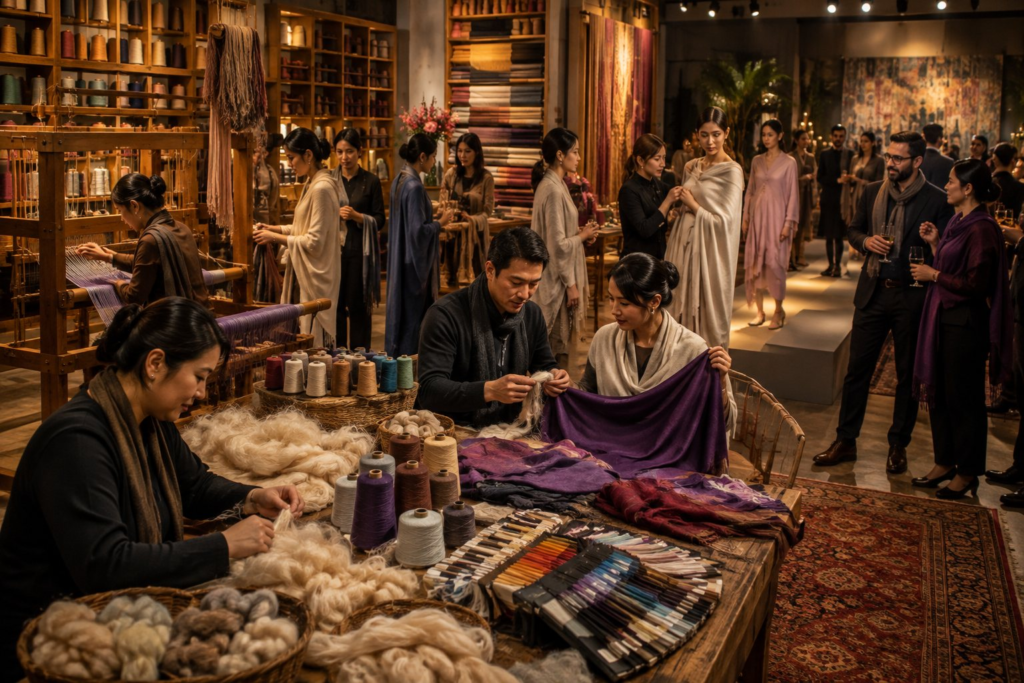
An experience-based model actually changes what is being sold. Imagine a pashmina studio in which visitors do not simply inspect finished shawls. They handle fibers and yarns, compare handspun and machine-spun material, experiment with colors, textures and drape, and work with craftspeople to customize a textile of their own. A workshop might culminate in an informal fashion show or party in which participants experiment with ways of wearing what they have made or selected. The textile remains valuable, but it is now part of an experience for which customers may themselves be willing to pay.
Information matters within such an experience, but information is not the experience. A complicated supply chain becomes something to explore. Questions about fiber origin, hand spinning, weaving, testing, traceability and environmental impact can be investigated through materials, demonstrations and encounters with the people who know the processes. The difference between Nepali and imported cashmere becomes a meaningful choice rather than an embarrassment. The survival of hand spinning becomes a skill worth witnessing—and perhaps trying—rather than a checkbox in a development program.
Even disagreement becomes useful. Does handwoven cloth feel better? Is finer always better? Does geographical origin matter? Is a Nepali shawl made from Chinese yarn less Nepali? Is hand spinning worth its cost? What constitutes responsible animal husbandry? How much should a consumer pay for traceability? These are not problems that marketing must conceal. They are questions that participants can explore for themselves.
The Geography Is Already There
Nepal has an additional advantage that conventional textile strategy barely exploits: people already travel enormous distances to experience the country.
The pashmina industry therefore does not have to create every customer encounter from scratch. It can connect itself to an existing geography of movement.
A visitor may encounter Chyangra and pastoral landscapes in Mustang; processing and fiber education elsewhere; spinning, dyeing, weaving and design in Kathmandu; retail in the city or later online. Not every visitor needs to traverse the entire chain physically. Digital traceability, video, exhibitions and carefully designed demonstrations can connect the stages.
Nor must the experience be packaged as another tourist “attraction.”
It can exist at many levels: an excellent shop in which staff genuinely understand fiber and weaving; a manufacturer willing to show customers how products are made; a textile center combining demonstration, testing and interpretation; short workshops; university and design-school partnerships; exhibitions; visits to pastoral communities designed around their interests rather than the visitor’s demand for spectacle; online material allowing a customer to follow a product backward through its production.
The important change is conceptual.
Knowledge itself becomes part of the product.
That is particularly attractive for Nepal because knowledge weighs nothing.
A Different Kind of Luxury
Luxury is often treated as a synonym for high price. That definition is becoming less useful.
Industrial manufacturing can now produce extraordinarily refined goods at enormous scale. Perfect uniformity is no longer necessarily evidence of luxury; in many categories it is simply evidence of good machinery. Meanwhile, affluent consumers have access to more objects than they can use.
Scarcity therefore migrates.
Time is scarce. Attention is scarce. Access is scarce. Knowledge is scarce. Direct human connection can be scarce. ime is scarce. Attention is scarce. Access is scarce. Knowledge is scarce. Direct human connection can be scarce. A meaningful connection between an object and the place where it was made is scarce.
Nepal can compete in those dimensions.
This does not mean wrapping an ordinary shawl in a Himalayan story and multiplying the price. That is precisely the trap.
The textile must remain excellent. But once excellence is established, Nepal can offer something difficult for an anonymous global supply chain to reproduce: intelligible connection among material, maker, landscape and customer.
A customer who understands why a shawl is unusual does not need to be told repeatedly that it is “authentic.”
The customer knows what was experienced.
Beyond Fast Fashion and Slow Fashion
This is why I now think the familiar opposition between fast fashion and slow fashion is too small for Nepal. Fast fashion competes through speed, novelty, scale and low price. Nepal is poorly positioned to win that competition.
Slow fashion responds with durability, craft, ethical production and reduced consumption. Nepal is much better positioned there.
But the Experience Economy suggests a third possibility. Instead of asking only How should this textile be produced?, ask What can happen around this textile?
A shawl can become the focus of activities that extend well beyond its purchase. A visitor might spend an afternoon in a Kathmandu studio comparing fibers and yarns, trying hand spinning or weaving, working with a designer on colors and dimensions, and learning different ways to drape the finished piece. A buyer might visit weaving workshops or, farther afield, communities where Chyangra are raised. A customized shawl might be made for a particular recipient, with the customer participating in its design and knowing who made it. Testing facilities could let producers and customers see what can—and cannot—be established about fiber quality and composition. Craftspeople could be paid not merely to produce textiles but to teach, demonstrate and collaborate.
In this model, tourism is not simply a source of customers for pashmina shops. Pashmina itself becomes a reason to explore Nepal—and some of the knowledge, skills and relationships encountered along the way become things customers can pay to experience..
This does not eliminate the need for efficient production, good design, reliable delivery, testing or marketing.
It makes those things more important.
An experience built around a mediocre textile is still mediocre.
But an exceptional textile embedded in an exceptional experience occupies a competitive space very different from the one in which Nepal currently tries to persuade shoppers that its cashmere is more authentic than somebody else’s.
Stewardship Is Not a Marketing Claim
This brings the argument back to where it began.
The strongest case for developing Nepal’s Chyangra Pashmina sector is not that the Himalaya provides an attractive story for selling expensive shawls. It is that carefully designed economic activity may help make continued life in mountain communities viable, and that viable communities are indispensable participants in stewardship.
But the direction of causation matters.
It is tempting to reason backward from the desired conclusion: Chyangra are indigenous to the mountains; pastoralism is traditional; pashmina provides income to pastoralists; therefore increasing Chyangra Pashmina production promotes mountain stewardship.
Every step in that sequence requires evidence.
Higher fiber prices may improve pastoral livelihoods. They may also encourage more animals, alter herd composition or increase pressure on particular grazing areas. Greater demand may help sustain transhumance, or it may increase the burden on a livelihood already losing labor to more attractive alternatives. Domestic processing may retain more value in Nepal, but a processing plant in Lalitpur does not automatically transfer that value to mountain communities. Traceability may create a premium for Chyangra fiber, but only if customers value the distinction enough to pay for the system required to document it.
None of these objections argues against the project.
They argue for treating stewardship as an outcome to be measured rather than a virtue to be presumed.
What Would Stewardship Look Like?
A stewardship-oriented pashmina strategy would begin by asking somewhat different questions from a conventional export strategy.
Are participating pastoral households economically better off, after their additional labor and costs are counted? Is the distribution of benefits equitable enough to retain participation? Are younger people choosing pastoral work because it offers a credible livelihood rather than because other opportunities are unavailable? Are herd sizes and grazing patterns compatible with the condition of local rangelands? Are veterinary services improving as dependence on livestock income increases? Can households survive a severe winter, disease outbreak or market collapse without catastrophic debt?
And what happens to the animals themselves?
If Chyangra Pashmina is to carry animal-welfare associations, the relevant measures extend beyond the method used to collect fiber. Nutrition, disease, mortality, shelter, handling, transport and end-of-life disposition all belong in the picture.
The same principle applies farther down the chain. If processing is described as environmentally responsible, measure water and energy use, chemicals and waste. If employment is a development objective, examine wages, skills, working conditions and the durability of the jobs created. If hand spinning is supported as a livelihood, establish whether spinners can earn a viable return for the extraordinary skill and time the work requires.
The point is not to create an impossible certification regime in which every shawl carries the burden of solving rural poverty, climate change and animal welfare.
It is to stop using those objectives as adjectives.
Sustainable, ethical, traditional, authentic and responsible should describe findings, not aspirations.
The Value Chain Needs Feedback Loops
The familiar value-chain diagram runs in one direction:
goat → fiber → processor → yarn → manufacturer → exporter → customer
But a resilient system needs information moving backward as well.
What qualities do manufacturers actually need from the fiber? Which characteristics of yarn matter to weavers? Which fabrics and designs do customers use and repurchase? Which provenance claims affect purchasing decisions? How much will customers pay for traceability? Which interventions actually improve pastoral incomes? What happens to rangelands as incentives change?
Without those feedback loops, each stage can optimize for an imagined demand farther down the chain.
Farmers can be encouraged to produce fiber that manufacturers do not particularly need. Processors can be equipped to produce material at a cost manufacturers will not pay. Manufacturers can create “authentic” products for customers who are primarily interested in color, drape or design. Marketing campaigns can emphasize sustainability without knowing whether sustainability influenced the purchase.
The problem is not peculiar to Nepal. Development projects everywhere are vulnerable to supply-side enthusiasm: identify something a community can produce, improve production, and then look for somebody to buy it.
Luxury markets are especially unforgiving of that sequence.
The customer has to be present conceptually from the beginning.
Start With Curiosity, Not Claims
This suggests a different approach to international market research.
Instead of beginning with the proposition that consumers increasingly demand sustainable, traceable and authentic products, ask what particular consumers actually want to know.
Put textiles in front of them. Let them compare fabrics without seeing the labels. Ask what they notice. Explain differences in fiber, yarn, weave and finishing. Show them products with different levels of provenance. Test willingness to pay. Find out whether a customer who expresses concern about sustainability actually chooses the product carrying the additional cost.
And do not assume there is one “international consumer.”
A Japanese buyer, a Turkish designer, a European luxury retailer, an American online customer and a visitor in Kathmandu may value completely different things. Even within a single market, one customer may care about micron count while another cares about color and drape, another about animal welfare, another about handwork, and another simply wants an unusually beautiful gift.
That diversity is an opportunity.
Nepal does not need a universal story.
It needs enough knowledge to offer the right product and the right information to different customers without making claims it cannot support.
Research Is Productive Infrastructure
This is why research should be treated as infrastructure for the pashmina sector rather than as an academic supplement to it.
Nepal needs better longitudinal information about Chyangra populations, fiber yield and quality, age and sex differences, pasture use, animal health and household economics. It needs reliable testing capacity accessible to manufacturers and processors. It needs market research capable of distinguishing stated consumer preferences from actual purchasing behavior.
It also needs people who can translate among these worlds.
A fiber scientist, a pastoralist, a spinner, a weaver, a designer, a salesperson and a luxury customer do not necessarily mean the same thing when they say “quality.” Yet the product ultimately incorporates decisions made by all of them.
The knowledge problem is therefore partly institutional. Expertise remains siloed.
A salesperson may know almost nothing about goat husbandry or spinning. A fiber producer may know little about how a shawl drapes or launders. A manufacturer may depend on a yarn supplier’s specification without having independent means of verification. A development specialist may understand value-chain diagrams while having little experience of what makes one textile more desirable than another.
The solution is not to make everyone an expert in everything.
It is to create places and processes in which expertise meets.
Their most useful function may be to make expertise available across the industry: so that fiber characteristics can inform manufacturing, testing can inform purchasing, customer experience can inform design, and market demand can inform decisions farther back in the production chain.
Where Do We Go From Here?
The expiration of a five-year strategy provides an unusually good opportunity to resist writing another one immediately. The first task should be to learn from this one.
One lesson may be that the value chain ends too soon. A conventional export strategy follows the product from raw material through processing and manufacture to market and sale. But the economic life of a pashmina does not end when somebody buys it. It is worn, noticed, discussed, photographed, lent, given away and remembered. Each of those events can create another encounter with the product—and potentially with Nepal.
That suggests several overlapping kinds of customers rather than a single market. The visitor already in Nepal needs a shopping environment in which buying pashmina is pleasurable and trustworthy: clear and policed fiber labels, visible and preferably fixed prices, knowledgeable sellers, reliable claims, opportunities for comparison and, at the more ambitious end, customization, workshops and participation in making and styling.
The overseas customer presents a different challenge. Nepal need not depend primarily on large foreign retailers to reach that customer. An armada of Nepali producers and sellers can develop direct relationships with relatively small groups of customers abroad, supported by shared testing, research, training, market intelligence and other services that individual firms cannot efficiently provide for themselves. The objective is not merely to complete a transaction, but to give owners reasons—and opportunities—to show, discuss, recommend and give pashmina to others. Trunk shows, community events, diaspora networks, mural exchanges and other forms of exchange can create such encounters without reducing promotion to conventional advertising.
A third customer may not initially be a customer at all, but a potential visitor. Someone encounters a Nepali pashmina abroad, hears the stories surrounding it, becomes curious about the places and people connected with it, and eventually comes to Nepal. Pashmina then reverses the usual relationship between tourism and handicrafts. Instead of tourism merely generating sales of pashmina, pashmina can help generate tourism—and perhaps repeat visits.
Gifting extends the circle further. A recipient may have had no previous interest in pashmina or Nepal. The gift creates the encounter involuntarily. Wearing it can provoke questions; learning about it can provoke curiosity; curiosity about a textile can expand into curiosity about the country from which it came. The recipient of one object can become a buyer, a giver, a visitor or simply the person who introduces someone else to Nepal.
The result is less a linear value chain than a circulation system: maker to buyer, buyer to wearer, wearer to observer, giver to recipient, customer to traveler—and sometimes traveler back to customer and giver. The strategic question therefore should not end with how Nepal gets more pashmina into foreign markets. It should include what happens after the sale, and how each encounter with a Nepali textile can create another encounter with the product, its makers, or Nepal itself.
First, Find Out What Worked
The appropriate question is not simply whether each activity was completed. It is whether the assumptions connecting the activities proved correct.
Did higher fiber prices increase collection sustainably? Did comb distribution materially change fiber recovery? What did farmers earn after costs? How much Nepali Chyangra fiber reached Nepali manufacturers? At what price and specification? How did it compare with imported material? How much of the new processing capacity was actually used? Did traceability function through the entire chain? Did the Chyangra Pashmina mark affect buyer behavior? Which export markets grew, and why?
Most importantly, which parts of the intervention created value that would continue without donor support?
Those answers should determine the next strategy rather than being fitted retrospectively into the previous one.
Several priorities already seem clear.
1. Keep Imported Cashmere in the Picture
Imported yarn should stop being treated implicitly as evidence of an incomplete Nepalese industry. It is an input.
Nepalese manufacturers should be able to choose among excellent international yarns and traceable domestic Chyangra material according to the product they are trying to make. Domestic fiber should earn its place through characteristics, provenance, flexibility or value that manufacturers and customers actually want.
That makes Nepal’s industry more resilient, not less.
2. Let the Chyangra Resource Determine the Scale
The ITC technical work provides a useful corrective to fantasies of immediate industrial integration. Nepal’s domestic fiber resource is small.
Treat that as a design constraint.
A small quantity of well-characterized fiber can be valuable. It can support limited-edition products, specialized yarns, design collaborations, research and genuinely traceable luxury textiles. Higher value per kilogram may be more useful to mountain communities than pursuing volume for its own sake.
If production eventually expands sustainably, processing can expand with it.
The machine should follow the resource, not the reverse.
3. Measure the Mountain System
Any expansion of Chyangra production should be accompanied by monitoring of the pastoral system on which it depends.
That means rangelands, herd composition and movement, animal health, mortality, household economics, labor and climate-related risk. The appropriate scale is local enough to detect differences among production areas rather than treating “the Himalaya” as a single ecosystem.
The objective is not to prove that Chyangra production is sustainable. It is to discover under what conditions it is sustainable.
4. Make Testing Ordinary
Fiber testing should cease to be something invoked mainly when certification or export compliance requires it.
It should become part of ordinary commercial knowledge.
Processors should know what is in each lot. Manufacturers should be able to verify important specifications. Designers should be able to relate measurable properties to textile performance. Salespeople should understand enough to explain claims accurately.
The result would be more than consumer protection.
It would allow Nepalese producers to learn systematically what their materials can do.
5. Separate Provenance From Quality
Nepalese origin is not a substitute for textile excellence.
The Chyangra Pashmina mark can identify a meaningful category of product, but it should not imply that every product carrying the mark is automatically more beautiful, softer, better designed or more durable than a product made from excellent imported cashmere.
Those are achievements manufacturers still have to earn.
Paradoxically, making that distinction could strengthen the mark. It would tell customers exactly what Chyangra Pashmina guarantees rather than asking a logo to carry every desirable association at once.
6. Stop Selling “Authenticity”
Sell identifiable things.
Sell known fiber. Sell exceptional weaving. Sell unusual design. Sell hand spinning where the hand spinning contributes something worth having. Sell traceability when the traceability is real. Sell responsible husbandry when it can be documented. Sell Nepalese manufacture proudly whether the yarn came from Mustang or Mongolia, provided the label tells the truth.
And where the history is complicated, tell the complicated history.
Complexity is not necessarily a marketing liability when the customer is invited to understand it.
7. Treat the Customer as a Participant
This is the largest departure from the five-year strategy.
The next phase should experiment not only with new products but with new forms of engagement: demonstrations, textile interpretation, workshops, design collaboration, transparent factory visits, fiber education, better-trained retail staff, digital provenance and connections between tourism and manufacturing that extend far beyond the souvenir shop.
Some will fail. That is precisely why they should be experiments rather than another national slogan.
The question is whether Nepal can turn knowledge, access and participation into forms of value that complement the textile itself.
If it can, the pashmina sector begins to occupy a much more interesting economic space.
Pashmina Dreams: The Next Five Years
The National Pashmina Sector Export Strategy 2022–2026 deserves more credit than it will receive if judged only against its US$75 million export target. It identified genuine weaknesses and helped narrow some of them. Processing infrastructure was built. Farmers received equipment and training. Fiber collection increased. Producer prices reportedly rose. New commercial relationships emerged, and traceable Nepali Chyangra fiber moved some distance from aspiration toward practice.
But five years of implementation also make the limits of the original model easier to see. More domestic links do not automatically make a value chain more valuable, resilient or sustainable. Nepali Chyangra fiber need not displace imported cashmere to justify its development, and a distinctive farm-to-finished-product line need not become an authenticity test that depreciates the much larger Nepali industry already built around imported yarn.
The opportunity is larger if the sector is understood as an ecosystem rather than a single chain. It can accommodate Chyangra and imported fiber, hand and industrial spinning, handlooms and power looms, pastoralists and scientists, designers and retailers, visitors to Nepal and customers who may never come. What connects them need not be a single provenance. It can be reliable knowledge about materials, processes, quality, environmental effects and customer preferences—and the ability to turn that knowledge into better products and richer encounters.
That also changes how infrastructure should be judged. A fiber-processing center is valuable if there is enough appropriate fiber to process and if processing it creates value. Its success should not require producing more goats simply to keep machinery busy.
And if Nepal ultimately discovers that its sustainable Chyangra supply cannot keep the Lalitpur facility operating at the scale originally imagined, even that need not make the investment useless. Perhaps part of the plant becomes a laboratory, training center or visitor center: a place where people can see fiber being sorted and processed, compare materials, meet producers, learn to spin or weave, design a shawl, attend a show, and encounter the people and landscapes behind the textile. A processing plant built to complete the value chain could become a place where the value chain meets its customers.
Five years ago, the dream was to complete the value chain. The next step is to find out how much Nepal can build around it.
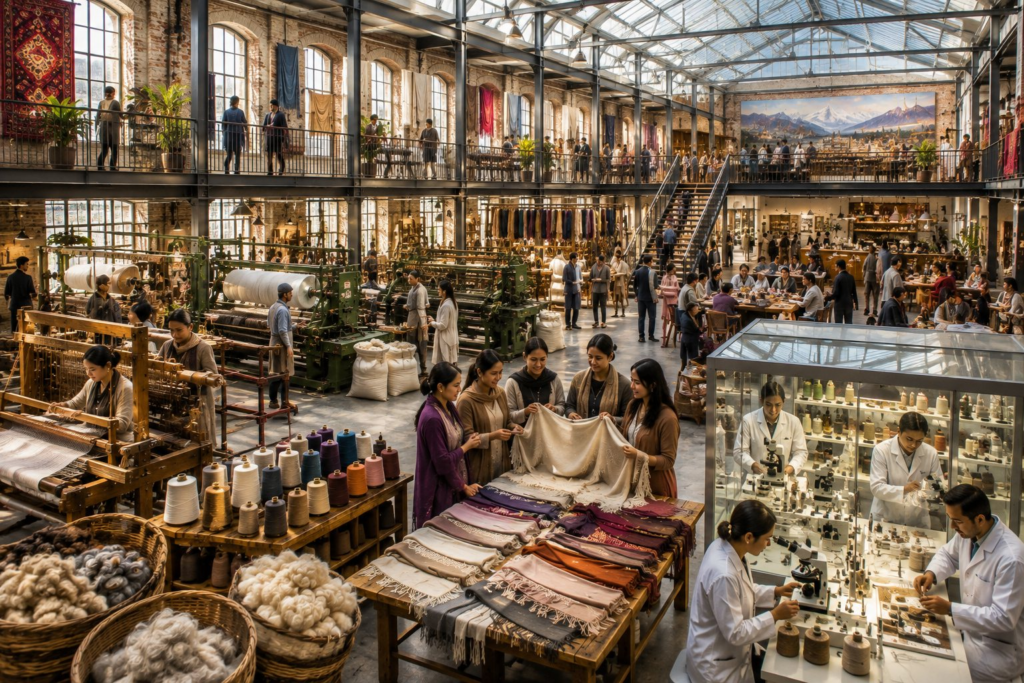
Sources
Associated Press. 2025. Report on environmental pressures, crowding and management of tourism on Mount Everest.
European Union Delegation to Nepal. 2023. “Nepal launches National Pashmina Sector Export Strategy to increase exports to USD 75 million (Euro 68.7 million) by 2026.” 7 February 2023. Accessed August 11, 2026.
https://www.eeas.europa.eu/delegations/nepal/nepal-launches-national-pashmina-sector-export-strategy-increase-exports-usd-75-million-euro-687_en
Federal Trade Commission. “Cachet of Cashmere: Complying with the Wool Products Labeling Act.” U.S. Federal Trade Commission. Defines the conditions under which fiber may legally be identified as cashmere in the United States and explains that pashmina is not a separate fiber designation recognized under the Wool Act and Rules.
Government of Nepal. Products from Nepal: A Handbook of Major Export Potential Products. Section on Chyangra Pashmina.
Government of Nepal, Ministry of Agriculture and Livestock Development. 2024. Agriculture Development Strategy: Progress Report 2024. Discussion of implementation of livestock insurance and government premium subsidies.
Government of Nepal, Ministry of Culture, Tourism and Civil Aviation. 2025. Nepal Tourism Statistics 2024.
Government of Nepal, Ministry of Foreign Affairs. 2026. “One Hundred Days Performance of Ministry of Foreign Affairs.” 4 July 2026. Section on Nepal’s graduation from Least Developed Country status.
Government of Nepal / Ministry of Industry, Commerce and Supplies / Trade and Export Promotion Centre, with technical support from the International Trade Centre. 2022. National Pashmina Sector Export Strategy 2022–2026.
International Trade Centre. 2023. “Reviving Nepal’s Luxury Pashmina Wool Exports.” 7 February 2023.
International Trade Centre. 2024–2025. Project reporting and updates on the EU–Nepal Trade and Investment Programme and Chyangra Pashmina value-chain development, including fiber collection, comb distribution, farmer prices, training and processing facilities.
Khadka, Manbar S., and Ganesh Thapa. 2020. “Economic and Financial Returns of Livestock Agribusiness in High Mountains of Nepal.” Journal of Agriculture and Rural Development in the Tropics and Subtropics. Analysis of 138 livestock enterprises in ten high-mountain districts, including Chyangra enterprises. DOI: 10.17170/kobra-202010191973.
Lee, S. H., and G. Jha. 2022. Pashmina Fibre Transformation in Nepal. Technical study prepared in connection with International Trade Centre support to Nepal’s pashmina sector. Analysis of Chyangra fiber availability, collection, dehairing and processing, spinning feasibility, costs and value-chain constraints.
Nepal Pashmina Industries Association. “Lab Testing / Code of Conduct.”
Nepal Pashmina Industries Association (NPIA). n.d. “About Us.” Accessed August 11, 2026. https://nepalpashmina.org.np/about-us/
Pandey, Luma Nidhi, and Resham Gyawali. 2013. “Constraints and Potential of Goat and Sheep Production under Transhumance Management System in the High Mountain Regions of Nepal.” In Proceedings of the National Workshop on Research and Development Strategies for Goat Enterprises in Nepal, pp. 92 ff. Nepal Agricultural Research Council / Sheep and Goat Research Program.
Pine, B. Joseph II, and James H. Gilmore. 1999. The Experience Economy: Work Is Theatre & Every Business a Stage. Boston: Harvard Business School Press.
Prasain, Krishana. 2023. “National Pashmina Sector Export Strategy Launched.” The Kathmandu Post, 7 February 2023.
Trade and Export Promotion Centre, Government of Nepal. “Pashmina Products.”
United Nations Development Programme. 2021. “How Sustainable Cashmere Is Reversing Land Degradation in Mongolia.” 15 June 2021.
World Bank. 2016. “Building a Peaceful, Prosperous and Just Nepal.”
World Bank. 2020. Sustainable Tourism Enhancement of Nepal’s Protected Areas. Project documentation.
World Bank. 2020. “COVID-19 Impact on Nepal’s Economy Hits Hardest Informal Sector.”
World Bank. 2024. “Saving Nepal’s Tigers and Livelihoods.” Material on conservation, natural capital, livelihoods and nature-based tourism.
World Bank. 2026. Nepal Development Update: Growth Under Pressure—Navigating Domestic and Global Shocks.
Additional comparative source
“Age-Related Variations in the Population of Active Secondary Hair Follicles, Oxidative Stress and Antioxidant Parameters in Cashmere Goats.” 2024. Animals 14:1350. Study of Inner Mongolian cashmere goats aged two to seven years. Used here only as comparative evidence that cashmere yield, staple length and fiber diameter can vary with age; its findings should not be assumed to apply directly to Nepalese Chyangra.
Leave a Reply